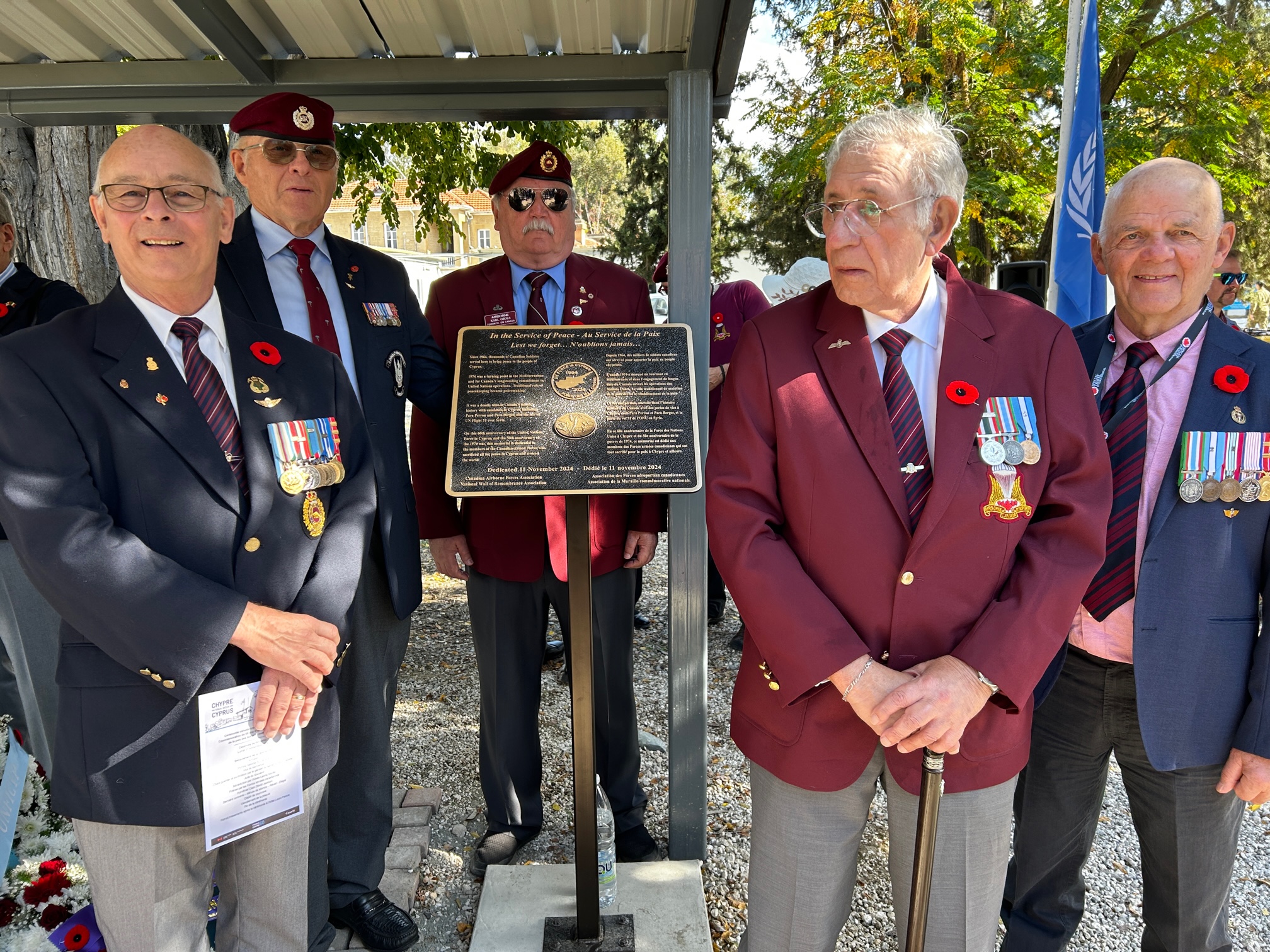
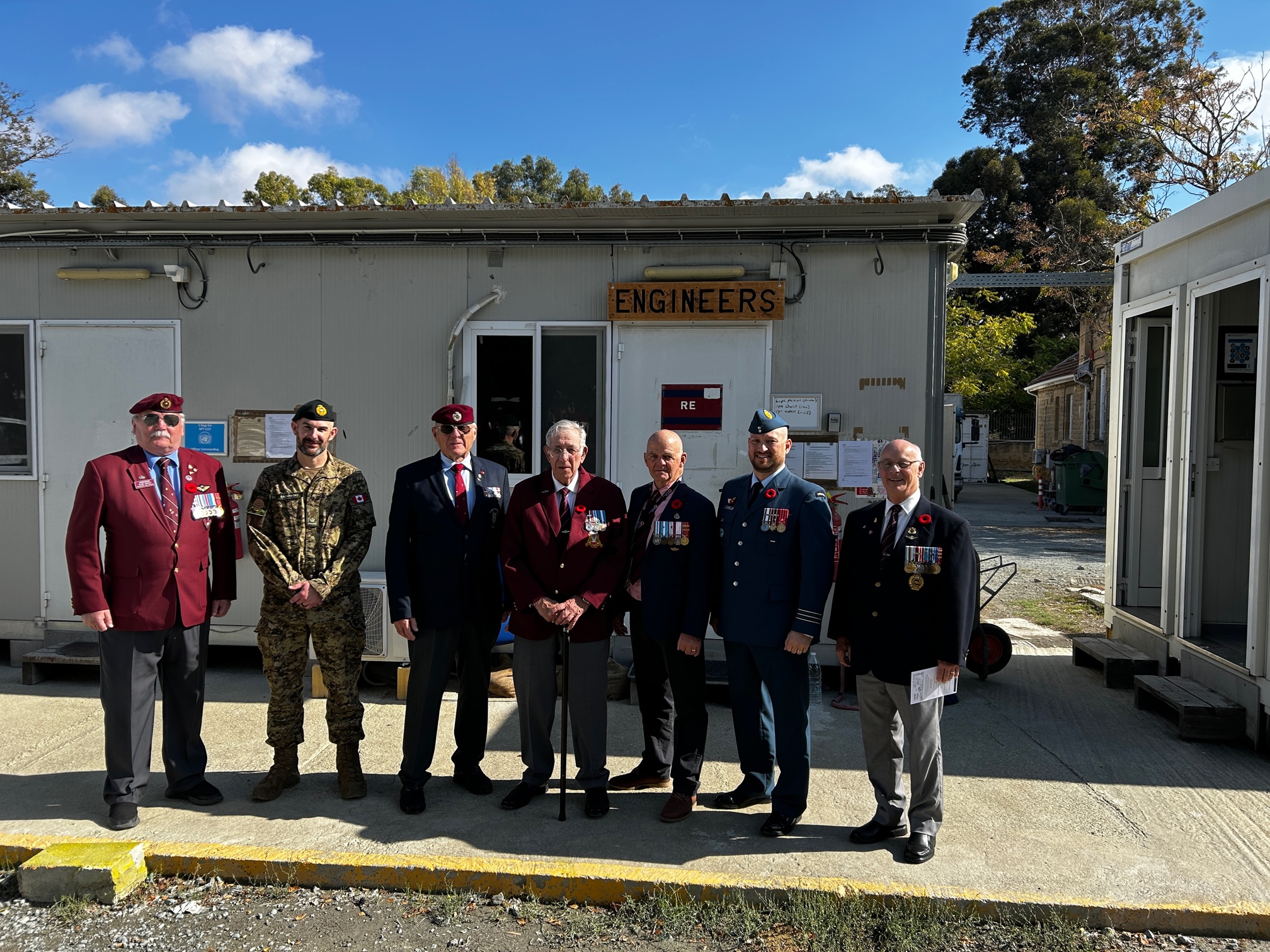
Over a six-day period in early November, five Engineer veterans and a serving engineer officer joined by 100 other veterans and family members, participated in a pilgrimage to the island of Cyprus to mark the 60th Anniversary of the initial deployment of the United Nations Force in Cyprus, UNFICYP and the 50th Anniversary of the Turkish Invasion in 1974.
Background
Following a Greek-led coup against Cypriot President Archbishop Makarios III on 15 July 1974, and the peace talks that fell apart a few days later on 20 July, members of the Canadian Airborne Regiment, including 1 Commando and 1 Airborne Field Squadron, a force of about 480 all ranks, found themselves at the very centre of the action when Turkish paratroopers landed in their operational area. The Turkish goal was to seize the Nicosia International Airport and then reinforce their foothold on the Island. With most of 1 Cdo occupied in and around the Ledra Palace Hotel, the defence of the airport fell to Engineer Major Dave harries, CO of 1 AB Fd Sqn, and OC of the Canadian Contingient (CANCON) Logistics Company. A quickly assembled force including engineers, cooks, clerks, mechanics and others were deployed around the airport. These Canadians, with the later assistance of a small British force of armoured cars and a flight of Royal Air Force Phantom jets, were instrumental in stopping the initial Turkish force from seizing the airport and controlling access in and out of the city of Nicosia. This in turn, allowed the warring sides to restart peace talks and prevent further violence on 24 July.
Over the next few weeks, the Canadian Airborne Regiment was reinforced by 2 Cdo, 1 AB Fd Bty and an armoured reconnaissance troop from the Lord Strathcona's Horse and more of their service support elements from Canada. This brought CANCON's strength to over 950 troops. Defensive positions were dug and manned, and active patrolling increased throughout the area. Antitank weapons, ammunition and armoured personnel carriers were brought from Germany and painted white. When the Turkish forces launched a second and considerably more powerful offensive on 14 August, the Canadians and others were hit with intense artillery and mortar fire in all areas. While some observation posts were abandoned, the Canadians held fast and were instrument in not only in preventing the Turkish’s forces from taking the airport, but likely saving the city of Nicosia itself when a second offensive was launched on 25 July. For more details on the role played by the Engineers, see Cyprus 74 - The Sapper Story for more details.
The Pilgrimage
The idea for the pilgrimage was initiated by Real Comeau, a former member of 1 Commando, in a conversation with his son, LCol Marc Comeau, past CO of 1 ESU and current EA to the Commander of the RCAF. Back home in, Marc discussed the idea with some members of the local retired military community and it took hold. A committee was formed and their hard work resulted in a lifetime experience for the 100 plus participants, journalists, documentary makers and others who were fortunate enough to attend and take part in the activities. Our grateful thanks is extended to them all.
The pilgrimage included a series of on site battlefield tours with the soldiers who were there. We were privileged to hear from engineer veterans of the battle including retired engineer MWO Archie Demeria who was serving with 2 Commando at the time, and retired Cpl Danno Schut who served in 1 Airborne Field Squadron.
The final event of the tour was a Service of Remembrance at Wolseley Barracks attended by Canadian and UN dignitaries, over 200 Canadian service men and women, including engineers, serving in the task force charged with assisting in a possible evacuation of Canadian citizens from Lebanon, media, and the 100 plus pilgrims. Including two killed and dozens wounded during the '74 action, 28 Canadian peacekeepers died over the life of our involvement in UNFICYP. They will be remembered.