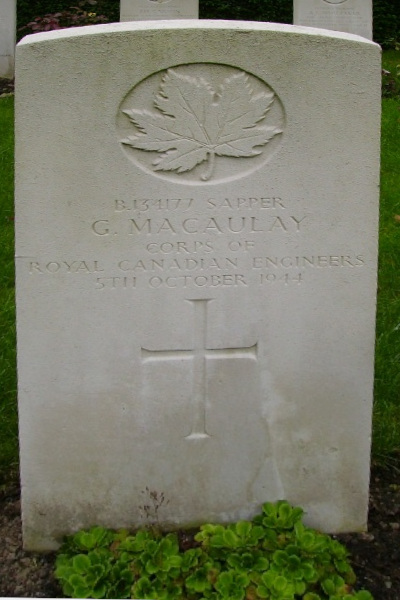
Gordon Macaulay was born in Dundalk, Ontario, son of Angus and Maud Macaulay. His father was a veteran of the First World War.
Gordon grew up in the area of Collingwood, Ontario and left school at age 14 years after completing Grade VIII. He had worked as a carpenter, cabinet maker, painter and had some auto-electric experience and was working as a carpenter in Kingston, Ontario when he enlisted in Owen Sound, Ontario on 8 October 1942. He was sent to Number 25 Basic Training Centre in Simcoe, Ontario as an infantryman, hoping to join the 48th Highlanders.
On 6 January 1943, Gordon was transferred to the 1st Chemical Warfare Mortar Company, Royal Canadian Engineers in Owen Sound. The 1st and 2nd CWM Companies has initially been formed in Suffield, Alberta, initially as cadres. By the time they were fully manned and training had begun in earnest, they were drawn down and finally disbanded at Camp Petawawa in September 1943 as they were no longer needed. Gordon was by that time fully trained and qualified as a Carpenter Group ‘B’. He was sent to A6 Engineer Training Centre in Camp Chilliwack, BC in August and sent overseas to the Canadian Engineer Reinforcement Unit in England in December. He was posted to the 2nd Field Company on 3 March 1944 and disembarked in France on 6 July 1944.
The company immediately started clearing the routes through Caen, bridging the Orne River and participating in the key battles to close the Falaise Gap. They worked on the approaches to the Seine and participated in operations to cross the river. They then turned their attention to the clearing of the Channel ports when an advanced reconnaissance party from the unit were among the first Canadian soldiers to re-enter Dieppe when it fell on 1 September 1944.
By 10 September, the company was in Ostend, Belgium putting the routes in and out of the port back into operation. By the end of September, they had worked their way as far as Antwerp and were preparing for operations to clear the Beveland Approaches. Action started on the night of 1 October and by 5 October, the company had moved forward over its bridges and cleared routes. As the infantry of the 2nd Division pushed forward, they remained at the front, often under fire. On 5 October, Number 3 Platoon had a mine-clearing party working near the village of Cappellen when a curious civilian stepped on a mine and killed himself and Gordon Macaulay. Two others were wounded.
Sapper Gordon Macaulay is buried in the Schoonselhof Cemetery in Antwerp, Belgium.
Return to Part 5: Tributes to the Fallen Sappers of the Scheldt