Raymond Rousseau was born in Jonquière, Quebec, the son of Adelard and Marie Anna Rousseau. He had an older brother and two younger sisters. He enlisted in Noranda, QC on 7 August 1941 and declared his civilian occupation as commercial artist and painter. He was sent right away to the 4th Battalion, Royal Canadian Engineers in Camp Petawawa, Ontario. A month later, he found himself in the United Kingdom with the rest of the battalion, landing in Scotland on 19 September 1941. The Battalion was quickly absorbed in the Canadian Military HQ Works Program to release field companies who had arrived earlier, back to their divisions.
Raymond started his basic and advanced sapper training on arrival while at the Engineer Reinforcement Unit. In July 1942, he returned to the 4th Battalion as qualified as a Bricklayer Group ‘B’. The Battalion converted to II Corps Troops in May 1943 and ‘C’ Company became the 31st Field Company. From the time of their arrival their work focused on construction of defence works, camps, roads and airfields. From that date onwards they would focus on field engineering tasks on the continent – bridging, route construction and repair, water supply and mine and obstacle removal.
On 7 June 1944, the company was informed of the Normandy invasion. They immediately set out waterproofing their vehicles, kit and equipment, keen to go. However, their optimism was premature. It was a month later on 7 July, they were finally in France as part of 2nd Canadian Army Troops in support of II Canadian Corps. They went work quickly in Normandy taking on tasks of route construction & maintenance, bridging, minefield clearance, water supply and defence works construction. A notable accomplishment was the construction of the Churchill Bridge. (See Sapper Gallantry on the Orne). They took part in the battles of Bouguebus Ridge, Verrières Ridge and Calais.
After the Channel Ports, the company moved on the Battle of the Scheldt. In the second week of October, they took over the assault initial bridges over the Leopold Canal and built routes on both sides to support the 3rd Division’s advance through the Breskens Pocket. More than once they came under fire and suffered casualties. A few weeks later, they assisted in the amphibious attack from the south side of the Scheldt onto South Beveland Island in support of the British 52nd (Lowland) Division’s assault over the Scheldt, in turn to support the 2nd Canadian Division fighting its way out of the Beveland Isthmus. They built entry and exit ramps for amphibious vehicles as well as a Bailey pontoon ferry to take supplies and armoured vehicles across the 7-mile gap.
On 31 October, the company set out on an 80-mile route from the south bank to the Beveland Isthmus. Their tasks were to open and maintain the routes across the isthmus. This included maintaining two Bailey bridges at eastern end of the Isthmus, repairing roads, filling craters, and clearing the verges of the many mines left behind.
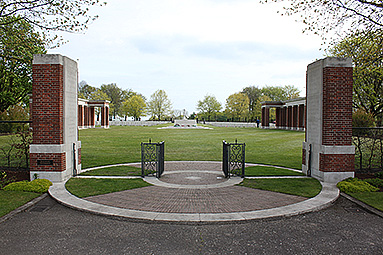
This work continued for a few more days. On the morning of 3 November, two members of 2 Platoon were involved in a serious mine accident. Sapper Raymond Rousseau, was killed outright and his comrade Sapper Nicholas James Hantiuk died of his wounds as a result. Sapper Rousseau is buried in Groesbeek Canadian War Cemetery. He was 22 years old.
Return to Part 5: Tributes to the Fallen Sappers of the Scheldt