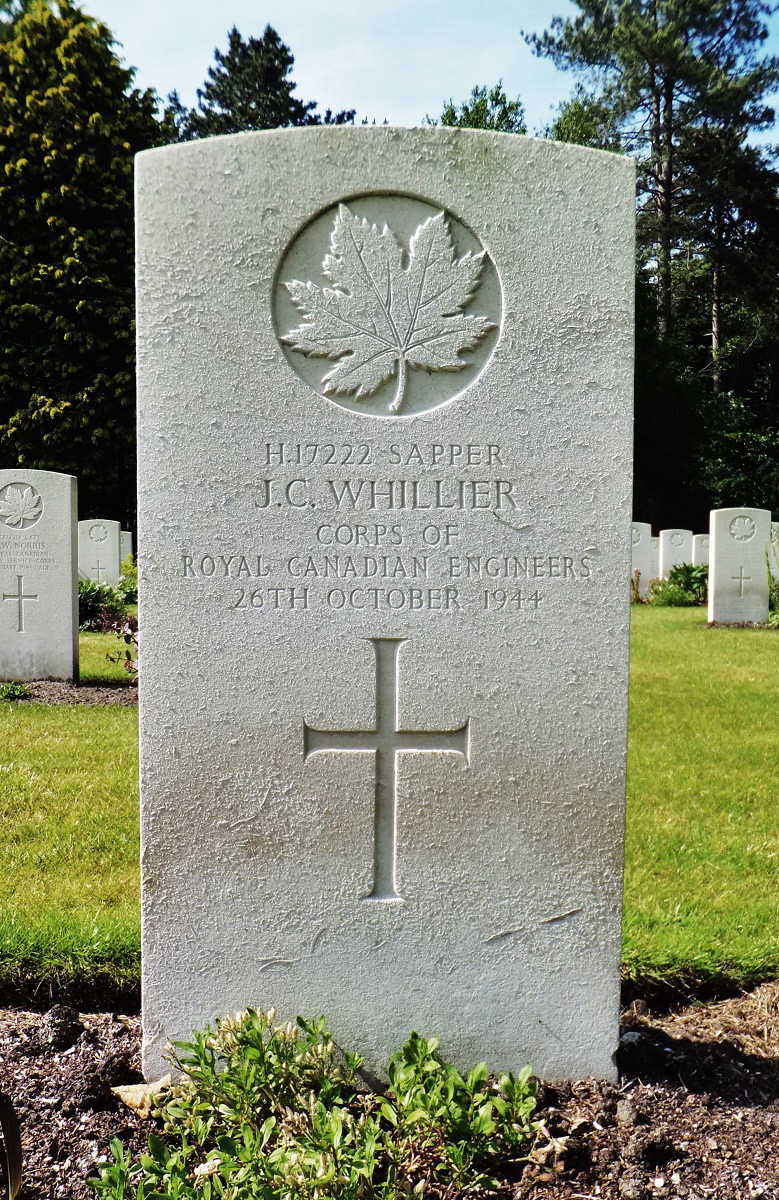
Joseph Charles Whillier was the son of Ernest and Leo Whillier of Brandon, Manitoba where he was born. He completed Grade 8 in Brandon and Grade 10 in Windsor, Ontario when his mother re-located after his father’s death. He later moved to Winnipeg, Manitoba and found work as a labourer. He was married with an infant son when he enlisted in the Princess Patricia’s Canadian Light Infantry on 6 April 1940 in Winnipeg and had an infant son. On enlistment, he mentioned he wanted to be an electrician. He completed his Basic and Advanced Infantry Training at Number 15 Army Basic Training Centre in Shilo, Manitoba.
Joseph travelled to the United Kingdom with the PPCLI, arriving in Liverpool on 20 October 1941. In November at his request. he was transferred to the Number 7 Construction Company, Royal Canadian Engineers as a sapper. He qualified as an Electrician’s Helper in January 1942 and by April he was qualified as Electrician Group ‘C’ and paid as such.
On 10 June 1942, Joseph was taken on strength of the 4th Battalion, RCE. When the 4th Battalion reorganized to form II Corps Troops Engineers in May 1943, Joseph’s company was re-designated the 29th Field Company, RCE. While employed primarily on building and construction tasks, the 4th Battalion had already started training for this new role in January 1942. Joseph continued his training and qualified as a driver and as a ‘Detector Doctor’ during that time. In June 1944, before he arrived in France, he was re-classified as a Pioneer Group ‘C’ (Electrician).
The 29th Field Company started arriving in Normandy in late June 1944. Joseph and remaining men arrived on 7 July and joined the company. They completed a myriad of tasks during the Battle of Normandy, especially in and around Caen, rafting the Orne River and its canals and quays. An especially interesting task was a 150-foot Class 9 single-single Bailey bridge from one quay to another on the Orne Canal. The 23rd Field Company replaced that bridge with a triple-double Class 40 bridge two weeks later. This bridge was dubbed the ‘Reynolds’ bridge after an officer who had recently been killed.
After the Normandy Breakout, the 29th Field Company continued forward with II Canadian Corps. They bridged the Somme and the Seine, and built more bridges and cleared routes along the coast and into the Low Countries. In October, they supported the 3rd Division’s amphibious attack into the Breskens Pocket working in the Terneuzen area. They then supported the 52nd (Lowland) Division’s amphibious assault over the Scheldt and into South Beveland Island.
This latter assault was launched in the early morning darkness of 26 October. The sappers landed before 0500 hours. Number 1 Platoon landed on Amber Beach and Number 3 Platoon landed on Green Beach. The LVTs started off-loading men and stores and the infantry moved rapidly inland, outflanking the Beveland Canal defences. The sappers on Amber saw little of the South Beveland. For the rest of the month, they lived in holes in the dike and maintained the dike-crossings and beach-tracks, and manhandled engineer stores ashore. Around the corner on Green beach, the story was different for 3 Platoon. The site came under fire from the start. Lance-Sergeant Gale and Sappers Tolfree and Whillier were killed and six others wounded during one ‘stonk’. While the platoon was working to prepare a ramp for a Terrapin ambulance, two other sappers were wounded. Continued fire made Green beach useless and after 1040 hours it was closed. The sappers were finally evacuated at 1500 hours with the last of the wounded on the last vehicle. The beach was abandoned
Sapper Joseph Charles Whillier was temporarily buried in Bearland in South Beveland and later transferred to Bergen Op Zoom Canadian War Cemetery.
Joseph’s brother, Clifford, served overseas with the 2nd Armoured Regiment (Lord Strathcona's Horse (Royal Canadians)) overseas in Italy and Northwest Europe.
Return to Part 5: Tributes to the Fallen Sappers of the Scheldt
Return to Part 5: Tributes to the Fallen Sappers of the Scheldt