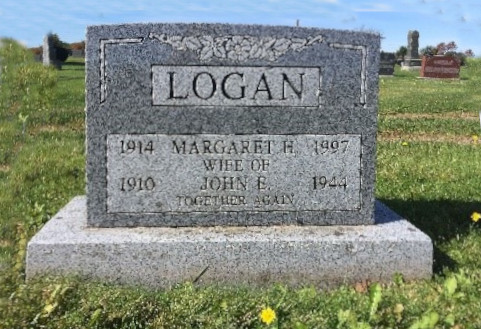
Sapper John Edward Logan was born and brought up in Truro, Nova Scotia, the son of William and Margaret Logan. As was very common at the time, John left school before graduating as soon as he finished Grade IX. He immediately started work and over the years he worked for a time in a sawmill, on a farm, in a warehouse, and for the Canadian National Railway where he was a carpenter. He could drive both a car and a truck, which at the time, was not as common as in the present day. He was married and had one brother and one sister.
John enlisted in Number 6 District Depot in Halifax, Nova Scotia on 28 August 1942 and put on the ‘general list’. He was 31 years old and had experience as a carpenter and a plumbers helper. He was sent to Number 65 Basic Training Centre in New Glasgow, Nova Scotia and then on to A5 Canadian Engineer Training Center in Camp Petawawa, Ontario to begin his sapper training. In February 1943, he went to the Advanced Driving & Maintenance School in Woodstock, Ontario and after two months of training, we qualified as a Driver-Mechanic Class 1 and Motorcyclist Grade III. In May, he also passed the tests to qualify as a carpenter Group ‘B’. In June, he was notified that his wife in Truro had borne a son, John Keith Logan. Later in November, he received a qualification at the Chemical Warfare School in Suffield, Alberta before returning to Petawawa. John never stopped learning. In April 1944, he qualified as a Bricklayer Group ‘C’ just before deploying to the United Kingdom.
On arrival in England, he joined the Engineer Reinforcement Center. On 26 May, he was sent to the 18th Field Company to cover a Pioneer position, even though he had not been so qualified. The 18th Field Company embarked for Normandy on 3 June 1944 and landed on Juno Beach in the assault wave on 6 June, D-Day. Most of the company landed on “Mike Red”, the current site of the Juno Beach Centre in Courselles-sur-Mer, and cleared beach obstacles and routes across the beach. Another platoon had been attached to the 5th Field Company and landed a full five minutes before the infantry to clear underwater obstacles in up to four feet of water before the incoming tide made the task impossible and they could be relieved by other engineers. The company continued inland that day, breaching obstacles in the dunes and in the minefields beyond. Over the next three months, John fought with his company in every engagement in the Battle of Normandy, helped cross the Seine with bridging and rafting operations, supported the clearance of the Channel ports and moved into Holland with the 3rd Canadian Infantry Division in preparation from Operation SWITCHBACK to clear the Breskens Pocket.
After having supported the crossing of the Leopold Canal and the amphibious assault across the Braakman Inlet, the company continued through the Breskens Pocket to the second German line of defence anchored on the towns of Breskens and Schoondyjke. The 9th Brigade launched their first attack on Breskens on the 21st of October and cleared to town by noon. A second attack was planned on Schoondyjke the following day.
The following day, before the attack, Number 3 Platoon was busy clearing the route to Schoondijke but made little progress due to sporadic shelling. As bad luck would have it, a friendly artillery ‘stonk’ fired at 11 o'clock to support the assault, fell short and a shell landed directly on the spot where a party from 3 Platoon had taken shelter. Sappers Logan and Love were killed instantly while Sapper Labarre was mortally wounded and died a short time later. Nine other sappers were wounded. The unit War Diary records this as "an Unfortunate Accident".
Sapper John Edward Logan is buried in the Adegem Canadian War Cemetery in Belgium along with 847 other Canadian soldiers. He was 34 years old when he died and left a wife and family in Truro. His family immortalized him by adding his name to that of his wife's on a grave marker in the Robie Street Cemetery in Truro.
Return to Part 5: Tributes to the Fallen Sappers of the Scheldt