
Neil Arthur Thompson was a native of Halifax NS. He had started high school but left at the age of 17 after the Grade IX to go to work. He married Muriel Eileen Smith on 18 September 1941 and they had a son, Roderick Neil Thompson born in Halifax.
Neil worked as a clerk at WD Piercey Lumber mill for 1½ years before he enlisted at No 6 Depot in Halifax on 15 August 1940. During the initial enlistment interviews, he stated that he had completed a year of technical school learning to be an electrician but wanted to be a plumber. His background as a clerk led to his being initially classified as a clerk and he was transferred to No 6 Detachment Royal Canadian Engineers in Halifax. He was later assigned to 23rd Field Company and was sent to A5 Canadian Engineer Training Centre in Camp Petawawa, Ontario on 17 April 1941 for training. Here he completed his basic Field Engineer training and then became qualified as a Carpenter on 21 October.
Neil joined 23rd Field Company in March 1942 after he completed his training in Camp Petawawa. At this time, the company was undergoing unit training at Sussex NB but soon concentrated in Debert NS with the rest of 2nd Corps Troops, RCE before the unit embarked for England from Halifax, NS on 16 July 1943. He embarked for the United Kingdom from Halifax on 16 July 1943 on the troop ship Pasteur and arrived in England on 22 July. In England, the Company continued training in preparation for a major role in the Invasion of Europe. Their final series of exercises in England (named “KATE”) before D-Day focused on assault river crossings.

of Andy's Alley in Caen
The plan for the Invasion of Europe had anticipated that the 23rd Field Company would land in France on D +20. The company disembarked on the shores of Juno Beach on 11 July and soon moved into the outskirts of Caen where they were responsible for clearing a roadway through the city of Caen. The city was in rubble from heavy Allied bombing and a route was necessary to support the advance. They were regularly under fire as the city was still hotly contested. His company soon moved into the outskirts of Caen where, under fire, they cleared a roadway through the rubble of wrecked buildings by demolishing obstacles, bulldozing rubble, clearing mines, and filling potholes that was vital to the Allied advance. The route became known as “Andy’s Alley” after Lieutenant A. B. Anderson of Headquarters R.C.E., 1st Canadian Army Troops). After clearing this route, they supported the Allied advance with more river crossings and bridge-building. One of the first bridges was the “Reynold’s Bridge” across the Orne River, named for one of their officers, Captain G. G. Reynolds, was had been killed two days before.

being evacuated in a storm boat
Following the company’s build of “Reynold’s Bridge” across the Orne River, the 23rd Field Company then supported a 4th Armoured Division assault crossing of the Seine River near Pont De L’Arche. Here they used the British stormboats that they had trained on extensively in England for a successful assault crossing under the occasional artillery and mortar fire. The 23rd Field Company next built a Bailey bridge across the Seine River in less than 24 hours and then supported the Allied advance into Belgium and Holland.
The 23rd Field Company played the major role in the evacuation of the depleted and encircled British 1st Airborne Division across the Neder Rijn River after Operation MARKET GARDEN. Sapper Thompson was a crew member along with Sapper Hope in the fourth stormboat to go across the river. Commanded by Corporal S.F. Smith, they were returning with a full load of soldiers evacuated from the north side when a mortar round landed beside the boat. Many of the occupants jumped to the far side of the boat and it capsized.
The only Canadian to survive was Corporal Smith whose statement follows:
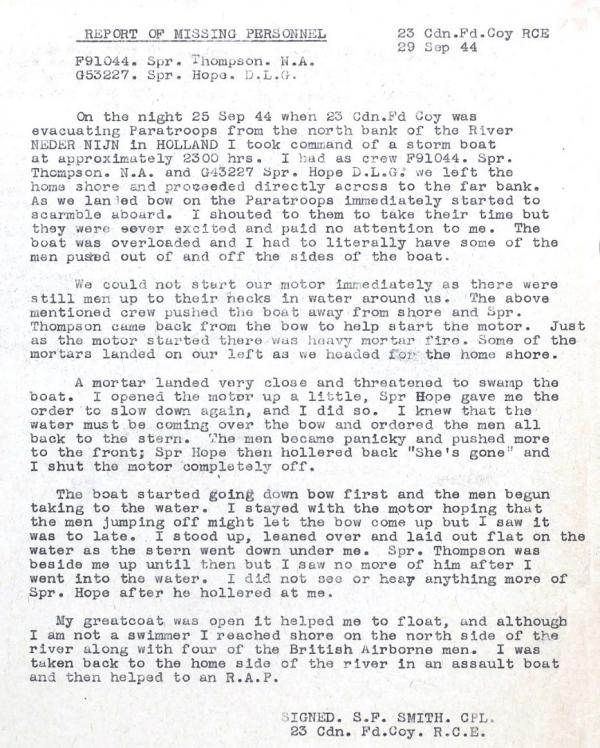
Originally declared “Missing”, then “Presumed Drowned” and, finally, “Drowned in Action,” after his body was recovered, Sapper Neil Thompson was buried in Groesbeek Canadian Military Cemetery in The Netherlands.
For his service to Canada, Sapper Thompson received the Canadian Volunteer Service Medal, the France and Germany Star, the Defence Medal, the 1939-1945 Star, and the 1939-1945 War Medal.
Prepared by LCol Ken Holmes (Ret’d)