 David Lloyd George Hope was born on 30 June 1919 in Moncton, NB. He was the second youngest in family of six children with two brothers and three sisters. Lloyd’s sisters Mildred and Kay were older than he was and Marguerite was younger. His older brother Russell was in the RCAF and his other brother Douglas served in the Canadian Army overseas.
He went by the name “Lloyd” and completed Grade Six at age 13. Lloyd was living in Lewisville, NB when he enlisted at Woodstock on 8 August 1942. He had been working as an Iron Moulder at the foundry of Record Stove and Furnace Company in Moncton NB for six years. Lloyd had previous military experience as a Gunner in the Militia with 8th Battery, Royal Canadian Artillery in Moncton (1940-41). At enlistment, he stated that he wanted to be a Blacksmith. He was initially assigned to No. 7 District Depot in Fredericton but he was assigned to the Royal Canadian Artillery on 2 October because of his gunner background. Lloyd was soon sent to No. 70 Canadian Army Basic Training Center for his basic training and subsequent qualification as a Fitter. He returned to No. 7 District Depot in February 1942 and, upon completion of more training, he was transferred to the Royal Canadian Engineers.
Lloyd was sent to A-5 Canadian Engineer Training Centre in Camp Petawawa Ontario on 8 April 1942 for his sapper training. Upon completion of this training, he was not posted to a particular unit in Canada but was identified as an Overseas Replacement. He soon embarked for the United Kingdom from Halifax on 2 June 1942. In England, he was taken on strength of No. 1 Canadian Engineer Reinforcement Unit prior to being assigned to a unit.

the rubble in Caen
Lloyd was assigned to 18th Field Company on 3 December 1942 and spent some time in Headquarters Royal Canadian Engineers at 3 Division Headquarters before being transferred to 23rd Field Company on 13 December 1943. That company was under training at the time in anticipation of a major role in the planned Invasion of Europe.
The 23rd Field Company embarked for Normandy on 6 July but it was 11 July before they disembarked on Juno Beach. The company soon moved into the outskirts of Caen where they were tasked to construct a military road for the Allied advance through the city of Caen. Caen had been extensively bombed by the Allies and was now an obstacle to their advance. The company cleared a new route through the rubble of wrecked buildings by demolishing obstacles, bulldozing rubble, clearing mines, and filling potholes. After clearing this route, they were occupied with supported the Allied advance - often by river crossing and bridge-building. The bridge that they built across the Orne River was named “Reynold’s Bridge” after a unit officer who had recently been killed.

rescue operations
The 23rd Field Company then supported a 4th Armoured Division assault crossing of the Seine River near Pont de L’Arche. The company had trained extensively in England on British “Stormboats” and this assault crossing was a successful crossing using this equipment under the occasional artillery and mortar fire. The 23rd Field Company next built a 110-ft Bailey Bridge across the Seine River at Pont de L’Arche in less than 24 hours. The company then supported the Allied advance into Belgium and Holland. In Holland, the 23rd Field Company played the major role in "Operation BERLIN"- the evacuation of the encircled and depleted British 1st Airborne Division forces on the far side of the Neder Rijn River.
Sapper Hope was to lose his life during this operation. On the night of September 25/26, Sapper Hope was a crew member in the fourth stormboat to go across the river. Commanded by Corporal Smith and accompanied by Sapper Thompson, they were returning with a full load of soldiers whom they were evacuating from the north side when a mortar round landed beside the boat.
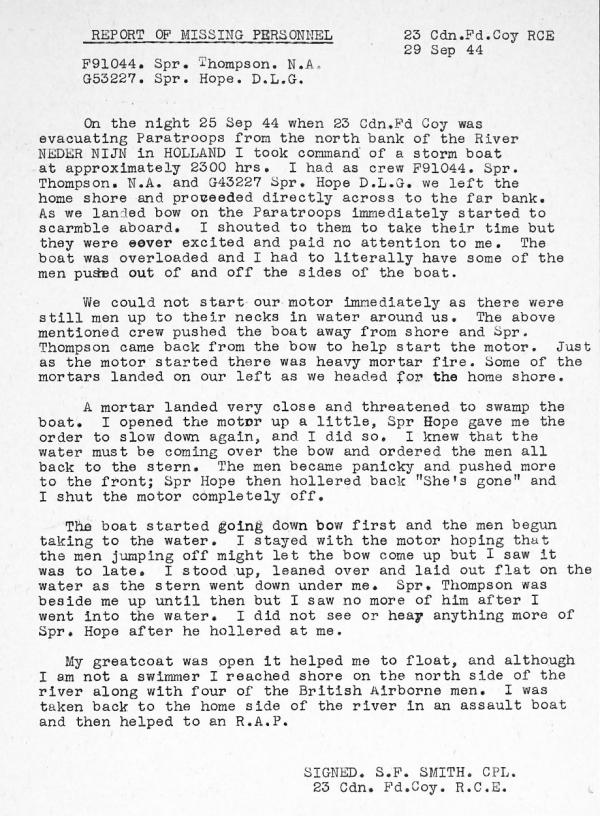
Corporal Smith’s statement describes the situation:
Sapper David Lloyd George Hope is buried in the Allied Plot in Rhenen Community Cemetery in The Netherlands. For his service to Canada, Sapper Hope was awarded the Canadian Volunteer Service Medal and Clasp, the France and Germany Star, the Defence Medal, the 1939-1945 Star, and the 1939-1945 War Medal.
Prepared by LCol Ken Holmes (Ret’d)