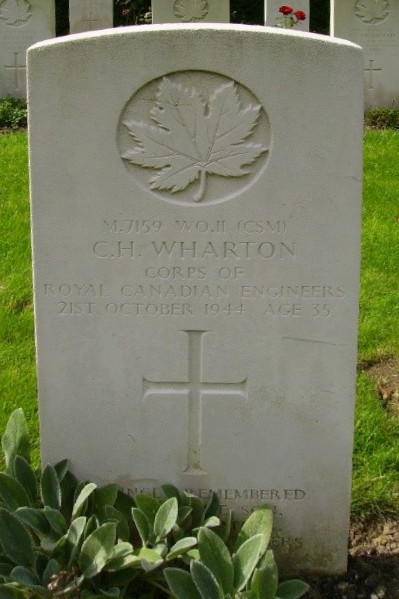
Clifford Henry Wharton was born Barrow-in-Furness, Lancashire in England, one of four children of William and Ruth Wharton. He completed two years at the Junior Technical School in Barrow-in-Furness and moved to Canada in 1927, settling with his family in Edmonton, Alberta. He was married and working as an auto refinisher and painter at Mills Motors when he enlisted in the Royal Canadian Engineers in Edmonton on 18 September 1939.
Clifford was appointed Lance Corporal and qualified as Pioneer Group ‘C’ in December 1939. Promoted to Corporal in February 1940, he was posted to the 1st Canadian Pioneer Battalion in Toronto in April and added Fitter Group ‘B’ to his trades qualifications. He disembarked in England in June 1940.
In December 1941, Acting Sergeant Wharton was posted from the Engineer Reinforcement Unit to the 1st Battalion, RCE. He was confirmed as sergeant in February 1943 and in January 1944, he was promoted to Warrant Officer Class II. The 1st Battalion, RCE was converted to 2nd Army Troops Engineers in March 1944 and its working companies, ‘A’, ‘B’ and ‘C’ was redesignated 32nd, 33rd and 34th Field Companies. Clifford was appointed Company Sergeant Major (CSM) the 34th Field Company in April.
The 34th Field Company arrived in France with a strength of nearly 300 officers and men on 9 July 1944 and set-up near Fontaine-Henry, north of Caen. They spent the majority of their effort on road work in the area. During the Crossing of the Seine, they ferried the Regina Rifles and the Canadian Scottish in stormboats over the river. They later operated rafts to get Canadian armoured units to the far side.
Following the Seine Crossing, the company continued forward supporting the 2nd Corps in a wide range of bridging and mobility tasks. When the Battle of the Scheldt launched on 2 October, the company was given a week for rest and preparation for follow-on tasks. Stormboat and bridging training continued along with ‘smartening drills’. As attention turned towards mine clearance tasks, the CRE commanding 2nd Army Troops Engineers assigned a task to build a ‘mine circus’ with which to train the other companies.
The company was soon on the move again and set themselves up in a chateau near Antwerp. The biggest issue was obtaining an adequate supply of timber for future bridging tasks and as most available timber had been already ‘requisitioned’, they turned their attention to cutting and sawing their own. Meanwhile, they took over the operation and maintenance of floating bridges as divisional engineer companies continued to support forward troops.
On 20 October, the platoons were busy bridging, repairing roads, logging and preparing to build a Class 40 raft that night. During the day, CSM Wharton had collected a few crates of German Rieglemines that had been left at the side of the road. He stored the mines in the unit quartermaster stores for safekeeping. It was his job to supervise the collection and rendering safe of enemy mines for exhibition in the unit’s mine circus.
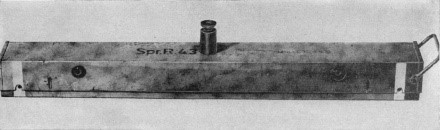
The Riegelmine was a long rectangular shaped antitank mine produced in great numbers between 1943 and 1945. It contained 4 kilograms of explosive and was double-fused. The mines were extremely dangerous. Their fuse mechanisms corroded easily and although the pressure plate operated at between 180 kilograms at either end and 360 kilograms in the centre, the slightest touch could set one off. The situation is complicated by the fact that Riegelmines could be fitted with up to three anti-handling devices. The recommended render-safe procedure for any Riegelmine is to destroy it in situ by detonating a small explosive charge next to it.
The following morning, CSM Wharton had Spr Scott open a crate and take out one of the mines for a closer look. CSM Wharton had been trained on the Rieglemine two weeks earlier. They first removed the outer casing from the mine. Spr Scott then left the area and reported for morning parade and the weekly sock exchange. CQMS Jorgensen, who was standing by, advised the CSM to be careful, warning the mines may well have been booby-trapped. He saw two ignitors, one at each end of the mine. The CSM replied that he doubted that, as the stack of crates looked untouched when he found them. CQMS Jorgensen then left the QM Stores to go to the Company Orderly Room where it was his responsibility to censor all outgoing mail.
At 0812 hours, the mine exploded killing CSM Wharton instantly and destroying one or two days of combat supplies. The subsequent board of inquiry determined there was no negligence or improper conduct on the part CSM Wharton. His death was ruled as accidental in the line of duty. He is buried in the Schoonselhof Cemetery in Brussels.
Note: Clifford’s older brother, Major Stanley Wharton, served in the Canadian Army in Ottawa. His trade was Mechanical Engineer. He was killed in a plane crash in Kentucky and is buried in Beechwood Cemetery in Ottawa.
Return to Part 5: Tributes to the Fallen Sappers of the Scheldt