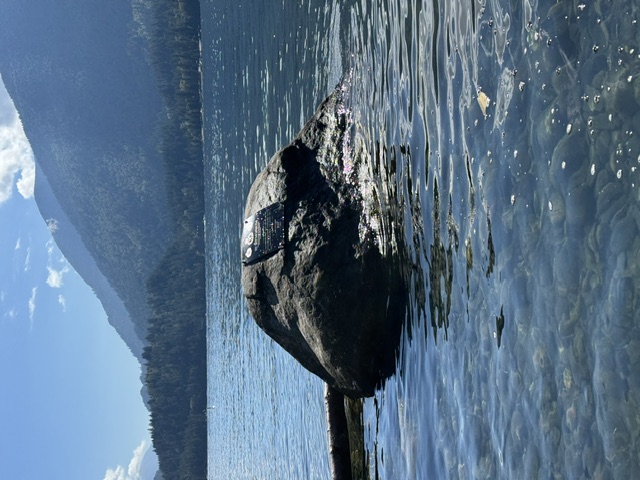
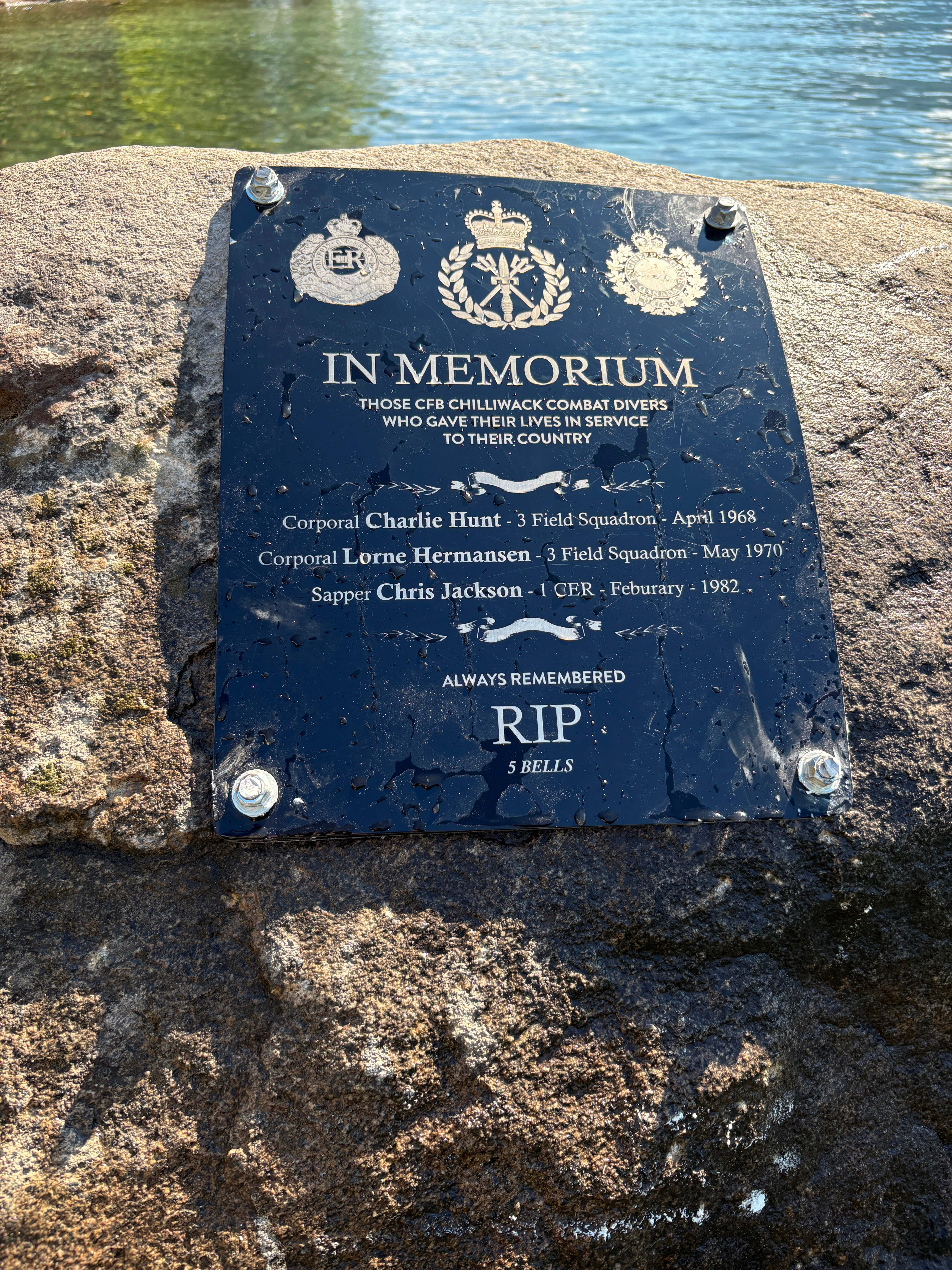
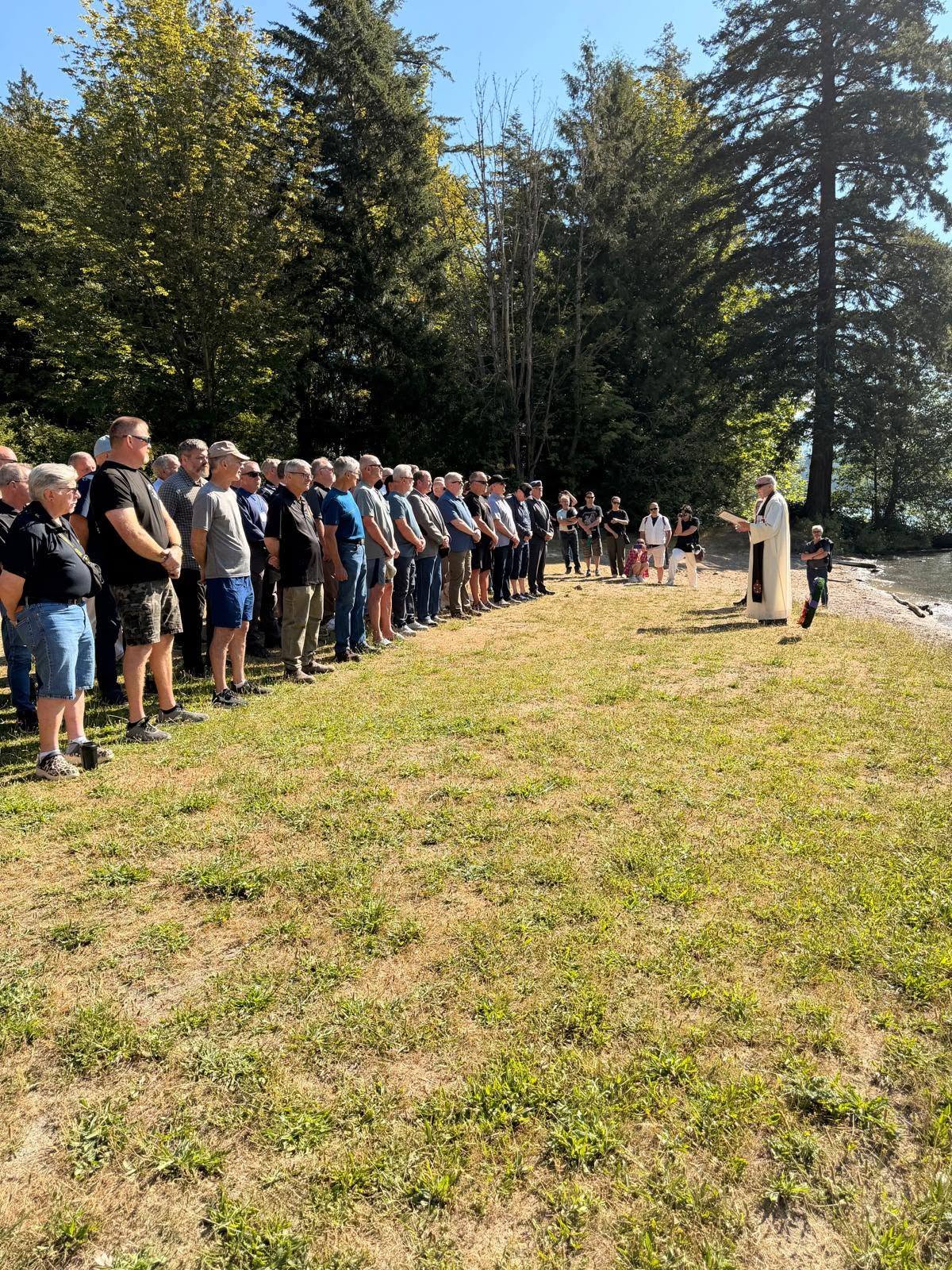
On the morning of 19 July 2026, nearly 50 Combat Divers, along with their families and friends, gathered at the former CFSME rafting area on the shores of Cultus Lake to dedicate a memorial honouring Combat Divers who lost their lives in service.
The monument was funded through the generosity of the Combat Divers Association of Canada and Op GRANITE II. A commemorative plaque was designed and mounted through the dedicated efforts of Brian English.
The ceremony was intentionally simple and dignified, reflecting the style of memorial services held at previous Combat Diver reunions. Combat Diver Gerry Duguid served as Parade Sergeant Major, Combat Diver Doug Foreman commanded the parade, and Combat Diver Steve Jackson provided the traditional piping.
The service was led by Major, the Reverend Albert George Fowler, OMM, CD (Ret'd), whose thoughtful and moving address became the centrepiece of the ceremony. A 25-year veteran of the Canadian Armed Forces, Padre Al's military service included postings to Petawawa, Gagetown, Cornwallis, and Cyprus during the 1970s. Following his military career, he continued a lifetime of service through leadership roles with Scouts Canada, the Canadian Authors Association, Storytellers of Canada / Conteurs du Canada, the British Columbia Conference and General Council of the United Church of Canada, and the Board of Directors of the Canadian College of Performing Arts. An accomplished writer and broadcaster, he has also produced several television programs for COGECO and Shaw Television. Now residing in Victoria, Padre Al remains an active contributor to his community, and we were honoured that he agreed to lead this important ceremony.
The ceremony began with the traditional Diver Roll Call, conducted by the Parade Sergeant Major at the water's edge.
Padre Al's address was far more than a blessing. His words captured both the solemnity of the occasion and the unique character, commitment, and sacrifice of Canada's Combat Divers. Rather than attempt to summarize a message that resonated so deeply with those in attendance, it is more fitting to present his address in its entirety, exactly as it was delivered.
The Padre's Address
Good morning, ladies and gentlemen, honoured guests, former and serving members of the Canadian Military Engineers, and especially those who served as Combat Divers.
We gather this morning in a spirit more specific from that of last evening, though the bonds of comradeship remain the same. Today we gather to remember Combat Divers,… and we have come to unveil and dedicate this stone in honour of this small and remarkable company of military engineers: those who accepted the challenges, risks and responsibilities of working beneath the surface of the water.
Many of you gathered here knew that work personally. You knew the training, the cold, the weight of the equipment, the limited visibility, the dependence upon one another, and the disciplined calm demanded when things did not go according to plan. Others come as families, friends, colleagues or members of the public. Whatever brings us here, we stand together in gratitude and respect.
This Combat Diver Memorial stone has been placed so that those who served will be remembered, and so that those who pass this way in years to come may ask:
Who were these people? What did they do? Why should they be remembered? This morning, we begin to answer those questions.
Reflection: Beneath the Surface
Much of military engineering is plainly visible. We see the bridge crossing the river, the road through difficult country, the fortification, the cleared route, the restored building and the supply of clean water.
The work of the diver is different. Much of it is done beneath the surface—out of sight of commanders, comrades and the public. Those standing safely on the bank may see only the surface of the water. They may see the bubbles, perhaps those waiting above., perhaps nothing at all. They cannot see clearly what the diver sees—or often does not see. Beneath the surface, familiar senses become unreliable. Light diminishes. Sound behaves differently. Direction can be uncertain. Cold reaches through equipment and clothing. Silt stirred by one movement can reduce visibility to almost nothing.
In such a place, equipment matters. Training matters. Procedure matters. But above all, trust matters. A diver must trust the people in charge of the operation, the equipment prepared by others and the companion working nearby. The diver must remain disciplined, communicate clearly and carry out the task. This was never an occupation for solitary heroes. It demanded teams. It demanded people who knew that their lives might depend upon the quiet competence of the person beside them.
That is one reason this memorial is important. It does not merely commemorate a skill. It honours a community formed through discipline, hardship, danger, humour and mutual reliance. It honours those who went beneath the surface so that others might cross safely, move forward, recover what had been lost, remove what threatened life, or better understand what lay hidden below. Their work was largely unseen. Their service should not be.
The Story and Purpose of the Memorial
Army diving grew from the work of the Royal Canadian Engineers in the late 1960s and from the need to carry engineer skills into rivers, lakes, canals and other inland waters.
Those selected for diving were Sappers first and foremost. Their environment was not necessarily the open sea or the great depths associated with naval diving. Their world was often shallow water—but shallow did not mean safe or simple. They worked where water met the land: at bridges, crossings, obstacles, approaches and shorelines. They conducted reconnaissance, inspection, construction, recovery, placement and removal of explosive charges, and other demanding engineer tasks above and beneath the surface.
They worked in places where the bottom might be mud, rock, wreckage, wire or debris, and where visibility could disappear with a single misplaced movement. Those who qualified became part of a select community. The training demanded the highest degree of fitness, water confidence, technical knowledge, judgement and the ability to function calmly under pressure.
The memorial we unveil today honours all who accepted that challenge. It remembers those who served, those who instructed, those who supported the diving teams, and those whose friendships were forged through shared danger and shared accomplishment. This memorial has been created not to glorify danger, but to recognize duty. The memorial is placed here so that service once hidden beneath the water will remain visible in the life and memory of the Canadian Military Engineer family.”
Reading
A suitable reading is taken from Psalm 139. It speaks of the ancient human awareness that even in the farthest and deepest places, we are not beyond the reach of the Eternal:
Where can I go from your spirit?
Or where can I flee from your presence?
If I ascend to heaven, you are there;
if I make my bed in the depths, you are there.
If I take the wings of the morning
and settle at the farthest limits of the sea,
even there your hand shall lead me,
and your right hand shall hold me fast.
The reading does not promise that dangerous places will cease to be dangerous.
It offers something more honest: that no place—not darkness, depth, distance or uncertainty—is beyond the presence of God.
Last Post
There being no bugler present, we will now keep two minutes of silence in honour of the departed and in gratitude for all who served.”
Act of Remembrance
They shall grow not old, as we that are left grow old.
Age shall not weary them, nor the years condemn.
At the going down of the sun and in the morning,
We will remember them.
[Those present responded]
We will remember them.
[This was followed by the Pipers Lament, the casting of a wreath, and the unveiling of the monument.]
Padre Al continued.
We have spoken of service that was often hidden beneath the surface. We now bring this memorial into view. This covering is about to be removed, but the deeper purpose of this memorial is not simply to reveal a stone. It is to reveal a story.
It is to bring into public memory service that was often carried out beyond public sight.
It is to declare that the courage, skill and comradeship of the Combat Divers will not be forgotten.
[The memorial is unveiled.]
Words of Dedication
In the presence of former and serving Canadian Military Engineers, Combat Divers, families, friends and members of the community, we dedicate this memorial.
We dedicate it to those who served as Combat Divers; to those who entered cold, dark and uncertain waters in the service of others; to those who cleared the pathways; to those whose skill made passage safer and whose courage enabled others to accomplish their mission; to those who taught the craft and maintained its standards; to those whose lives were entrusted to their comrades; and to those whose names live on in memory.
May this stone stand as a lasting witness to their service. May it remind future generations that some of the most important work is accomplished beyond sight and without recognition. May all who pause here understand something of the courage, discipline and trust represented by this memorial. And may the fellowship of those it honours endure.
Prayer of Dedication
Let us pray.
Eternal God,
Creator of the earth and of the waters that cover it, we give thanks for those whose service is remembered here.
We remember the Combat Divers of the Canadian Military Engineers: those who trained with determination, worked with skill, faced danger with courage, and entrusted their lives to one another. We dedicate this memorial to their honour and memory.
May it stand when our voices have grown silent. May it speak to those who did not know them. May it preserve the memory of tasks faithfully carried out, dangers quietly faced, friendships formed and comrades never forgotten.
We pray for those who mourn, for those whose memories remain vivid, and for those who still carry the burdens of service.
Grant that all who look upon this stone may be moved not only to remember the past, but to serve faithfully in their own time: to protect life, to assist those in danger, to build where others have destroyed, and to bring hope where fear has taken hold.
May those who enter the waters return safely.
May those who wait upon the shore be sustained.
And when we enter depths beyond our understanding, may we know that we are not alone.
Amen.
Closing Reflection
A memorial stone is solid, enduring and visible. The work it commemorates often took place in a world that was fluid, uncertain and unseen. That contrast is fitting.
The stone gives permanence to memory. It tells us that the lives and service represented here will not simply disappear beneath the passing surface of time. Those honoured here belonged to the Canadian Military Engineers, whose motto is Ubique—Everywhere. Combat Divers carried that calling beneath the water itself. They went where their skills were required. They accepted difficult tasks. They depended upon one another. And they left a legacy worthy of remembrance. May this memorial call us to the same qualities: competence without arrogance, courage without display, calm in adversity, and loyalty to one another.
Blessing and Dismissal
May the God of earth and sea bless all who have gathered here.
May those who served know the gratitude of their comrades and their country.
May those who mourn be comforted.
May those who remember find peace.
May we leave this place with renewed respect for duty, service and friendship.
And may the bonds formed in difficult places remain strong through all the years to come.
Amen.
This memorial is now unveiled and dedicated.
Ubique! Chimo!