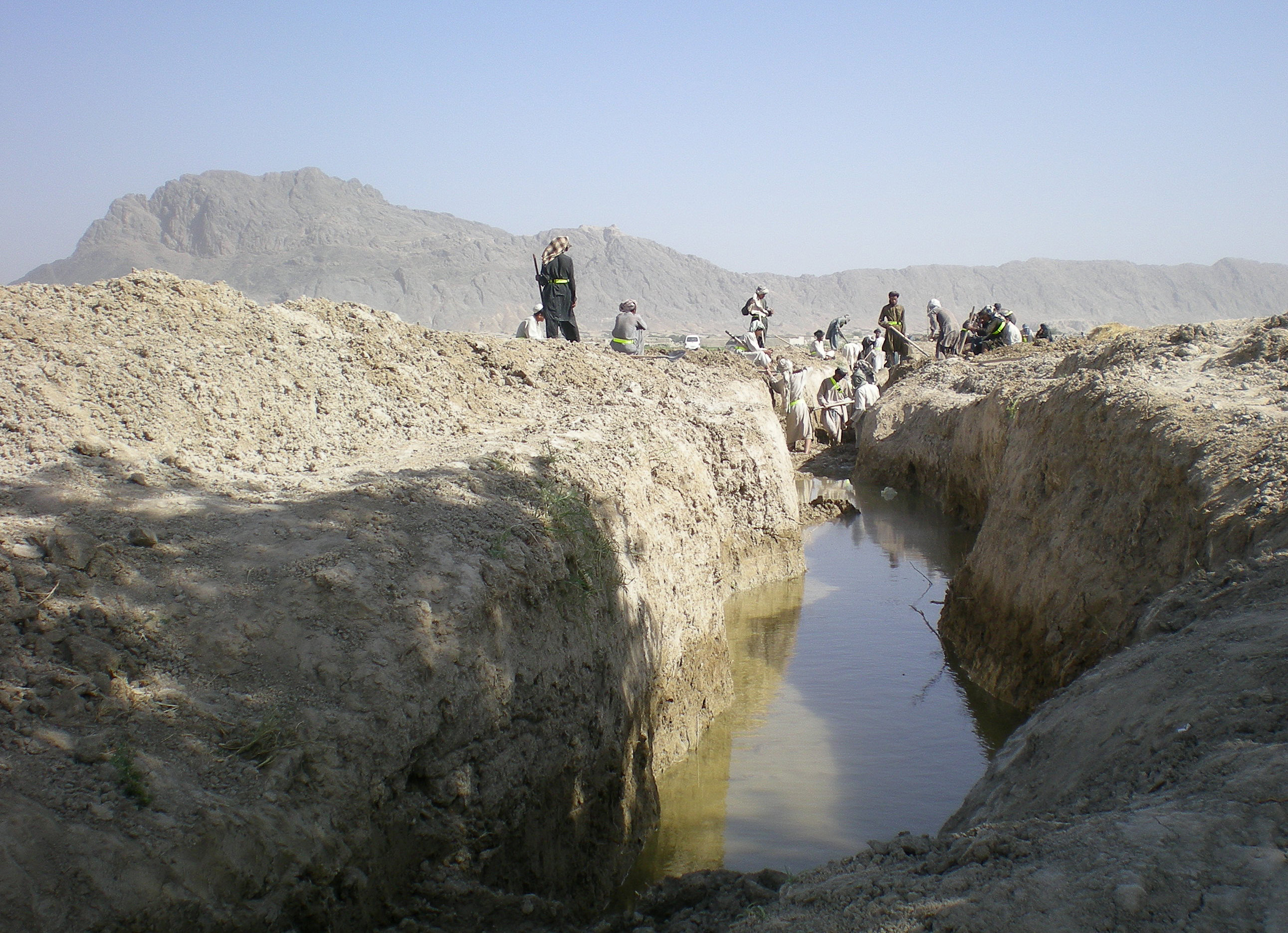
In late 2007, during the Afghanistan War, Task Force Kandahar planned to implement an 18-month “Shape-Clear-Hold-Build” counter-insurgency strategy. In early December 2007, 14 Construction Engineering Squadron (14 CES) was asked if the unit could assemble a team to form the nucleus of a unit to provide ‘a protected construction engineer capability.’ This was the genesis of the Construction Management Organization (CMO). After a quick staff check, the Commanding Officer said “Yes,” which started the formation of a Canadian Military Engineer team consisting primarily of Royal Canadian Air Force construction engineer reservists who would conduct counterinsurgency operations in Afghanistan.
14 CES had been deploying personnel since 1995 to locations around the world. The squadron had formed the core of the National Support Element Construction Engineering Section, which deployed to Camp Mirage in the United Arab Emirates in 2002-03 as part of Op APOLLO, and had also deployed a ‘construction-surge’ team to the Kandahar Airfield in 2006 to support Canadian-centric projects.
Having the squadron operating ‘outside the wire’ in Afghanistan was a completely new challenge; nonetheless, a team of 24 personnel (16 Reserve and 8 Regular Force) was assembled for the task. Of these, 14 CES provided two Regular and 13 Reserve Force personnel. Other members of team came from Bagotville, Valcartier, Greenwood, Borden, Gagetown, National Defence Headquarters and the Jamaican Defence Force. Training was conducted over nine months at various locations in Canada, the USA, and Jamaica.
CMO 3 arrived in Kandahar in early April 2009 and was quickly dispatched to Forward Operating Base Ma’shum Ghar and to Camp Nathan Smith. CMO 3 was under the operational control of Stabilization Company B, R22R (“Stab B”).
The recce team assessed the feasibility of implementing projects in the Dand District; another team closed out a road construction project in the Panjwai District; while yet another team prepared to deploy to the village of Deg-e-Begh. CMO 3 undertook projects such as irrigation canal remediation, road and bridge improvements, levelling artillery craters, and constructing new facilities and aqueducts. At its height, CMO 3 had almost 1,000 local fighting-age males working across three different geographic sites in the Dand District.
CMO 3 understood that their operations were a major irritant to the insurgents and that their workforce and work sites were high-value targets. The OC Stab B was informed that the Quetta Shura allocated 250 Pakistani Taliban to wipe out the Op KALAY project. The Vandoos and the Afghan Police thwarted all efforts to penetrate the ‘stability box’ to destroy the projects and kill the workers.
Civil-Military Operations were critical to success during the Afghanistan War. Construction Engineers demonstrated how these operations could be conducted ‘outside the wire.’ The cooperation and trust among the villagers, CMO 3, and Stab B prompted the Task Force commander to jokingly refer to the 14 CES group as the “Combat Team of Love.” When NATO Secretary General Anders Rasmussen visited Deh-e-Bagh, he was overheard to say, “I have got the very best impression. This is exactly the approach we will pursue in the coming years.”