CME Family Last Post

Our Last Post feature aims to notify colleagues of the passing of a comrade and to publish a short summary of their career and accomplishments to honour those who have served our country who died after 1 January 2000. As we receive news of the death of a member of the CME Family, we post an obituary along with funeral details and family wishes. We have done our best to ensure their completeness, with a focus on each person's service records and notable accomplishments.

Last Posts by Year: You can do a quick scan of our entries listed by year of death by clicking here.

Last Posts by Name: You can get an alphabetical listing of entries by clicking here.

Submitting Last Post Entries or Providing Additional Information: Click here to notify us of any Last Post entry we have missed or to send your comments, to provide additional information or to submit photos. For those who would like to help write Last Post entries, this link provides a guide.

Automatic Notification: You can receive automatic notification of the publication of each new Last Post by either registering for a RSS Feed service (see icon at lower left corner of this page or by joining the CMEA Last Post Facebook group.

Displaying 2801 - 2813 of 2813

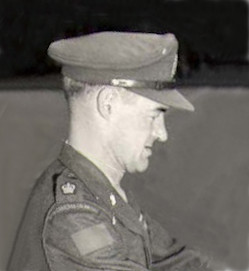
Brig John Robert Blakeley “Bob” Jones, OBE, DSO, MiD, CD, P.Eng. (Ret'd)

We regret to advise of the death of Brigadier John Robert Blakeley “Bob” Jones, OBE, DSO, MiD, CD, P.Eng. in Calgary, AB on 14 March 2000 at the age of 91 years.

Bob, or “JRB” as he was known, was born in Edmonton, AB in 1908. He showed an early interest in the military and was in the Army Cadets as a youth and later entered Royal Military College in Kingston, ON in 1925. He returned to Edmonton and joined the Canadian Officers Training Corps while attending the University of Alberta. Bob graduated in mining engineering from the University of Alberta in 1939 and enlisted in 1940 as an officer with Calgary’s newly formed 10th Field Squadron, Royal Canadian Engineers at the Mewata Armoury.

JRB followed the course of the war through North Africa, France, Belgium, Holland and Germany.  During the war he commanded the 10th Field Squadron, 31st Field Company, 4th Field Park Squadron, and 2nd Drilling (Tunneling) Company.  On 21 February 1944, after receiving senior officer training, he was promoted to Lieutenant-Colonel and appointed Commander, Royal Canadian Engineers (CRE), 4th Canadian Armoured Division. He held that appointment until the end of the war.

JRB has been credited with having a strong influence on the selection of the Bailey Bridge as the primary equipment for river crossings in Northwest Europe. At the time, other bridges were under consideration and there was much controversy what bridge should be used.  JRB ended to the argument in dramatic fashion.  In a demonstration for General Dwight Eisenhower, he outlined the advantages of the Bailey bridge and he and his men then set about erecting a 40-foot Bailey Bridge, complete with 10-foot ramps. The entire task was completed in 14 and one-half minutes. 

JRB described the task of military engineers in wartime as starkly simple - they must try to build while the enemy tries to kill them.  He lived by the motto: “First in, last out”.  He was a courageous man and led by example.  On the battlefield, he was a pragmatic and visionary engineer.  He was able to anticipate treacherous battle situations and prepare for them with daring and innovative actions.  He was named to the Order of the British Empire, awarded the Distinguished Service Order for bravery and twice Mentioned in Dispatches. Of these awards, he was very modest saying, he “just happened to be there.”

He was Commander, Royal Canadian Engineers (CRE) of 4th Canadian Armoured Division when he was named to the Order of the British Empire.  Leading from the front, he encouraged forward units by example under fire and ensured his determination to have the roads and obstacles clear for the division’s rapid advance was made clear to every sapper under his command.  His personal attention to the innumerable crossings of water obstacles confronting the 4th Armoured Division in the opening stages of the Scheldt Battle and his efforts to reduce any delay in the advance were mentioned in his citation.  Still, as CRE, he was awarded a Distinguished Service Order for bravery. The granting of this award for bravery to an officer of his rank was rare.  It was in March 1945 in Holland when the advance of the division was halted by a 75-foot crater.  The surrounding fields were impassable and the Germans had the site under constant observation and fire.  Due to the urgency of the task and the technical difficulties involved, Lt-Col Jones carried out the engineer reconnaissance personally in daylight.  The enemy opened fire at any sign of movement in the area and the lips of the crater were mined with anti-personnel mines. He returned to his field squadrons, gave his orders and returned with them to start the work under cover of darkness. He remained there under heavy mortar and machine-gun fire until the by-pass was completed at first light the next morning at which time the advance continued.  His leadership provided a constant inspiration to all those under his command.

After the war, JRB returned to Calgary and was appointed as District Engineer but within a month he was assigned the task of managing and maintaining the Northwest Highway System in Canada.  Even after six years of war, he regarded this as the greatest challenge of his career.  After three years as the Senior Engineer of the North West Highway System, Bob became Director of Works at National Defence Headquarters in Ottawa, ON and was appointed Chief Engineer of the Canadian Army from 1951-1954.  Later, as a Brigadier, he commanded the New Brunswick Area, returning to the Yukon in 1957 as Chief Highway Engineer.  

Bob retired from the Army in 1963 and went to work for a large construction company in Alberta. Following this, for 10 years he was Director of Campus Development at the University of Alberta, Calgary, and then with the Alberta Universities Commission. In 1970 he was appointed as the first Honorary Colonel of 8th Field Engineer Regiment in Edmonton, an appointment he held until 1973.  He remained vigorous until the last year of his life and was active in the Military Engineer Association of Canada, serving as President from 1965 to 1966. {dcSep2017gd} [zbd, zsp, zri]
Spr William Eastham (Ret’d)

We regret to advise of the death of Sapper William Eastham (Ret’d) on 9 March 2000 in Hamilton, ON at the age of 81 years.

William was born in Oldham, Lancashire, England and came to Canada as an infant.  He was a Second World War veteran who served with the Royal Canadian Engineers.  Records show he had qualified as Carpenter Group B by 1941. clerking and managing at various firms. He was a member of the Royal Canadian Legion. {dcJun2017gd} [zsd, zcc, zbd, zpp]

Spr James A. Fraser (Ret’d)

We regret to advise of the death of Sapper James A. Fraser (Ret’d) of Iroquois Falls, ON at the age of 75 years on 25 February 2000.

James served in the Royal Canadian Engineers and Royal Canadian Army Service Corps and was a veteran of both the Second World War and the Korean War.  He was a member of the Royal Canadian Legion Iroquois Falls Branch #70. {dcJan19} [zsd, zcc, zpp, zbd]

Joseph Duncan Wistard

We regret to advise of the sudden death of Joseph Duncan Wistard at his home on Whitehall Road, Parrsboro NS on 19 February 2000 at gthe age of 84 years.

Joseph was born in Kingston ON and was a Royal Canadian Engineer veteran of the Second World War. After the war, he operated Wistard Printing in Kingston for many years. After retiring, he and his wife relocated to Parrsboro and opened an antique business.

A funeral will be held on 21 February at Smith's Funeral Home in Parrsboro.

Willard Arthur Crooks

We regret to advise of the death of Willard Arthur Crooks of Charlos Cove NS in St. Martha’s Hospital in Antigonosh NS on 3 February 2000 at the age of 81 years.

Willard was born in Seal Harbour NS. He was a veteran of the Second World War and served with the Royal Canadian Engineers.  He was a member of the Royal Canadian Legion Tor Bay Branch #117 in Dartmouth, NS. 

Visitation will take place from 2:00 until 4:00 p.m. on 6 February at Aweeny's Funeral Chapel, Bridgewater, from where a funeral service will be held at 2:00 p.m. on 7 February. Burial will follow in the Hemford Cemetery, Lunenburg County NS.  Flowers will be accepted and memorial donations may be made to the Canadian Cancer Society. {dcMay2017gd} [zsd, zcc, zpp]

Spr Alphonse Delorme (Ret’d)

We regret to advise the death of Sapper Alphonse Delorme (Ret’d) of Pathlow SK on 30 January 2000 at the age of 85 years.

Alphonse was a Royal Canadian Engineer veteran of the Second World War.  He was a member of the Royal Canadian Legion Pathlow Branch # 344.   {dcJan18gd} [zsd, zcc, zpp, zbd]

Spr Samuel Ferguson (Ret'd)

We regret to advise of the death of Sapper Samuel “Sam” Ferguson (Ret'd) on 21 January 2000 of Waterloo, ON at the age of 79 years.

Sam was born in Killyberry, Northern Ireland and came to Canada with his family as a boy. He was a veteran of the Second World War and served in the Royal Canadian Engineers.  Sam was a member of the Royal Canadian Legion Branch #530 of Waterloo. {dcJan19gd} [ zpp, zsd, zcc, zbd]

Charles Curtis Greenhill

We regret to advise of the death of Charles Curtis Greenhill of Forest ON, on 19 January 2000 at the age of 80 years.

Charles was a Royal Canadian Engineers veteran of the Second World War. He was a member of the Forest Branch of the Royal Canadian Legion.

Charles is buried in Saint Anne's Anglican Cemetery in London. {dcFeb20wrd} [zsd, zcc, zpp]

LCol Albert J.D. Call, OMM, CD (Ret’d)

We regret to advise of the death of Lieutenant Colonel Albert J.D. Call, OMM, CD (Ret’d) peacefully at home on 14 January 2000 after a long illness at the age of 56.

Albert graduated from the Royal Military College Kingston ON in 1966 and was commissioned as a Sub-Lieutenant in the Royal Canadian Navy Civil Engineering List. His first posting was to the Royal Canadian Air Force Station Namao, Edmonton AB. Shortly thereafter, with unification of the Canadian Forces, Albert became one of only four Navy Civil Engineering List officers to join the newly formed Canadian Military Engineering Branch. He was sent to the Canadian Forces School of Military Engineering in Chilliwack BC to complete his Military Engineering Officer training and, upon completion of this training, was posted to 3 Field Squadron in Chilliwack. Other career assignments include Commanding Officer of 5e Escadron du Genié de Campagne in Valcartier 1974-76, Base Construction Engineer Officer Valcartier QC 1978-80, Senior Staff Officer Quartering at Mobile Command Headquarters in St Hubert QC 1980-83, and Director Military Engineering Requirements in National Defence Headquarters, Ottawa ON 1983 until his retirement in 1984.

After retirement, he pursued a 10-year career with the National Capital Commission in Ottawa, rising from Analyst to Director of Maintenance, then Vice President Land Management and Vice President of Human Resources. Albert then retired from the National Capital Commission to undertake private consulting work. He will be remembered for his contributions to the Military Engineering Trades Restructuring Study, the Canadian Commemorative Park in Vimy, France, and his work with the Canadian Forces Accommodation Agency. He eventually joined the CFHA staff as the General Manager of Operations.

A memorial mass will be held at the Annunciation of the Lord, Roman Catholic Church, 2414 Ogilvie Road, Ottawa at a date and time to be determined. Interment will be at Beechwood Cemetery in Ottawa. Donations may be made to the Canadian Cancer Society.{gdMay2016kh}

L/Cpl WIlliam John Greer (Ret'd)

We regret to advise of the death of Lance Corporal William John Greer (Ret’d) on 14 January 2000 in St Thomas ON at the age of 86 years. John was born in Ireland. He was a veteran of the Second World War and served in the Royal Canadian Engineers and the Canadian Provost Corps. John is buried in Fingal, ON.

Spr George Edward Bezanson (Ret’d)

We regret to advise of the death of Sapper George Edward Bezanson (Ret’d) on 6 January 2000 in the Duncan MacMillan Nursing Home, Sheet Harbour, NS at the age of 95 years.

George was born in Moser River, NS.  He was a veteran of the Second World War serving with the Royal Canadian Engineers in Belgium and Holland. After the war, he was employed with the Nova Scotia Department of Lands and Forests as a warden on the Liscomb Game Sanctuary.  He was a member of the Royal Canadian Legion Sheet Harbour Branch #58 as well as a member of the Freemasons Grand Lodge of Nova Scotia Eureka #42, also in Sheet Harbour.

Visitation will take place at the Ecum Secum Funeral Home in Moser River at 2:00-4:00 and 7:00-9:00 PM on 7 January with a Masonic Service at 7:30 PM followed by a Legion Service at 8:00 PM. The funeral will be held at 2:00 PM 8 January in St. Giles Presbyterian Church, Moser River.  Burial to follow in the church cemetery, Donations may be made to St. Giles Presbyterian Church or any charity of one’s choice.  {dcJan2017gd} [zpp, zsd]

LCol Mike Neil, CD (Ret’d)

We regret to advise of the death of Lieutenant-Colonel Mike Neil, CD (Ret’d) after a long illness in 2000* at the age of 59 years.

Mike was born in Rossland BC and started his lifetime association with the Royal Canadian Cadet movement by joining 1615 Royal Canadian Army Cadet Corps (RCACC) in Rossland High School.  After two years he enlisted in the Primary Reserve and served with 44 Field Squadron in Trail BC, followed by 12 Service Battalion in Vancouver, BC where he attained the rank of Warrant Officer.  In 1970, he returned to the Cadets where he was commissioned and served as a Cadet Instructor Cadre officer for the remainder of his life.

During his career in the cadet program, he commanded 2927 RCACC in Port Moody BC and 1838 RCACC in Maple Ridge BC.  He served at the Vernon Army Cadet Summer Training Centre from 1961 to 1992 in numerous functions including Platoon Commander, Training Officer and Company Commander. In 1989 he was promoted to the rank of Lieutenant Colonel and took command of the Vernon Cadet Camp, remaining in that position until 1992. He was the first Cadet Instructor Cadre officer to command the Vernon Army Cadet Camp.  In 1992 Mike moved to Ottawa to work in the Directorate of Cadets.  Over the nine years before his death he made many significant contributions to the Army Cadet training program, the national marksmanship program, the Dominion of Canada Rifle Association, the annual Cadet Summer Training Centre programs, the Army Cadet summer exchange program, the Youth Initiative additional weekend training and the new Army Cadet adventure training program.  {gdOct2016kh}[zsp, zri]

*Please note: The exact date of death is unknown

Cpl Clifford Oliver “Buster” Mandville (Ret’d)

We regret to advise of the death of Corporal Clifford Oliver “Buster” Mandville (Ret’d) of Ponoka AB in 2000.*

Clifford was born in Hanna, AB and was working as a coal miner in Rosebud, AB when the Second World War broke out. He was 26 years old when he joined the Royal Canadian Engineers in Calgary in June 1940.  After completing basic training in Camp Borden, ON, he served in England and in Northwest Europe with the 2nd Battalion, RCE, part of First Canadian Army Troops.  In England, his unit continued with personal training while constructing home defence facilities including bunkers, roads and airfields. 

Clifford advanced through the Sapper trades from Pioneer, Driver/Mechanic, Sheet Metal Worker and then as a Mechanic. He was in charge of the Battalion Workshop for 11 months. He arrived in France on 27 July 1944. The unit was employed primarily in the construction of permanent bridges across France and into the Low Countries.  Clifford was discharged in Calgary on 20 August 1945, a month after leaving Europe.

After the war, Clifford continued his mechanics training and completed a diesel engineering course in Canada before starting employment in Millet, AB,  He was working as a mechanic at the Reuben Plant when he retired.

Clifford is buried in the Millet Community Cemetery. {dcApr2018gd} [zbd]

*exact date unknown