When Harold Lancelot Abbott enlisted in the Canadian Army, he stated he was born in Brighton, England in 1893. His occupation on enlistment was rodman He arrived in Quebec City in a group of immigrants classified as ‘labourers and domestics’ in 1911. Three years later, he was living in British Columbia and unmarried when he enlisted on 9 Nov 1914 His service record says he was enrolled in the 30th Battalion, Canadian Expeditionary Force (CEF), a reinforcement unit raised in Victoria. After arriving in England, he was sent to the 15th Battalion (48th Highlanders of Canada) CEF on 15 May 1915 as a signaller. On 22 Apr 1917, he was transferred to the 1st Canadian Division Signal Company.
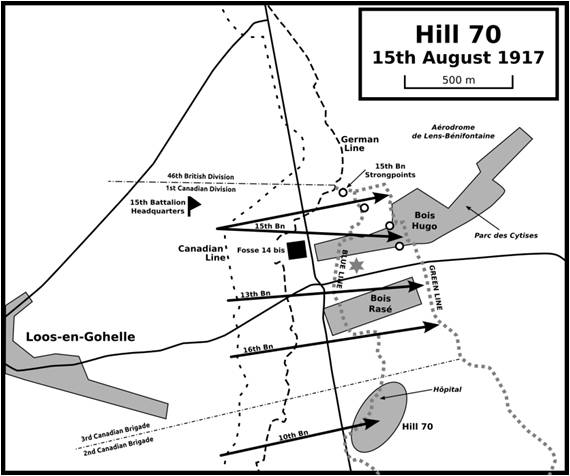
On 15 August 1917, the 1st and 2nd Canadian Divisions attacked Hill 70 The capture of Hill 70 was a key Canadian victory It was also the first major action fought by the Canadian Corps under a Canadian commander, General Sir Arthur Currie. Coming off the Battle of Vimy Ridge, the Canadian Corps was recognized as a formidable fighting force highly suited to spearhead attacks into German-held areas. Currie, having been ordered to capture the city of Lens, a charred ruin overlooked by Germans on higher ground, asked instead to assault Hill 70, a major feature dominating the city (whose highest point was 70 metres above sea level). He was granted permission after two months of preparation, and the Canadians advanced up the slope, countered German attempts to push them back, and captured the hill after four days of hard fighting on 18 August 1917. It cost Canada 9,000 dead and wounded. German losses were estimated at 25,000.
Communications between frontline units, their formations and especially supporting artillery units, were almost entirely by landline with limited wireless capability. The initial objectives, shown in the diagram, were to establish a series of strong points along the Green Line to form a base for follow-on troops to continue the advance During the initial advance, the Canadians fought off four strong German counterattacks before their goal was reached. As an Engineer soldier supervising the brigade signals office, Harold’s task was of utmost importance. Much of the credit for the Canadian victory, especially in the early hours, must go to the artillery but without a working signals network, that would not have been possible.
Harold was sent back to England in January 1918 suffering debility, a general term referring to general debility, muscle weakness, and weight loss. Early in his convalescence, a medical review board concluded he was no longer fit for service and recommended discharge. Although Harold blamed his ailment on the effects of a gas attack, there is no record of him having been injured on the date he said it happened. He was subsequently posted to the Canadian Engineer Training Depot at Seaford to await his return to Canada. His record outlines his total service as five months in Canada, 12 in England and 33 in France for a total of 50 months.
Harold married Kathleen Evelyn McCormick in Hailsham, Sussex, England, while convalescing. She arrived in Canada before his return and took up residence in Vancouver.
Harold arrived back in Canada on 4 January 1919 aboard SS Tunisian. He was living in Kimberly BC in 1924 and was listed as a commissioner for the Cranbrook Electoral District in government documents. Later, he was the Postmaster at Tulsequah, an unincorporated mining town in northwestern BC, from July 1953 until the Post Office closed in September 1957. Little else is known of his life after the war.
Harold Lancelot Abbott died in June 1965 and is buried in Kimberly, BC. His wife, Kathleen Evelyn Abbott died the following year, also in Kimberly.
On August 15th, 1917, Sapper Abbott set a splendid example of endurance under great mental strain when he worked continuously for twenty hours as a signal superintendent and operator owing to the heavy pressure of work in the brigade signal office, under heavy shelling and gas barrage.
Awarded MM on 21-09-17 (R.O 3327 Macdonnel) LG 30389 dated 19-11-17