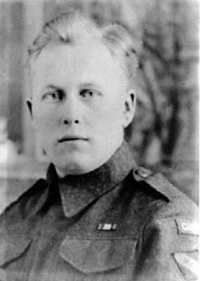
Sapper Harold Cecil Magnusson was the son of John and Emmie of St John NB. He had left high school during Grade 9 at the age of 16 to go to work. He had been working as labourer with Lantic Sugar Refinery in St John for two years when enlisted. Harold had previously served in the Non-Permanent Active Militia with No 2 and No 3 Fortress Companies (Electrical and Mechanical). He was single when he enlisted on 19 June 1942.
Harold’s brother Norman was a Commander in the Royal Canadian Navy. Two of his brothers-in-law were also in the Navy and another served overseas for the duration of the war. He had six sisters, one of whom was a sergeant in No 7 District Depot in Fredericton NB where he enlisted.
Within a few days of enlistment, Harold was assigned to the 23rd Field Company who where training in Sussex NB at the time. In November 1942, he was sent to the A5 Canadian Engineer Training Centre in Camp Petawawa ON and qualified as a Sapper and a Painter. After he completed this training in January 1943, he rejoined his unit. After six months of unit training in Sussex NB, the company embarked at Halifax on 17 July for the United Kingdom. In England, the company continued training in preparation for a major role in the Invasion of Europe. Their final series of exercises in England focused on assault river crossing.
On 11 July 1944, the 23rd Field Coy disembarked on the shores of Juno Beach. At first sight, the significant destruction of the war was not very apparent, but this changed as the company moved through to the outskirts of Caen that had been major battlegrounds. The city was in ruins as it had been very heavily bombed by the allies. The company was tasked with building a new roadway for the Allies’ advance through the demolished city. They were regularly under fire while they were bulldozing and removing rubble, clearing mines, demolitions and filling potholes. The new route became known as “Andy’s Alley”, named after Lieutenant A. B. Anderson of Headquarters
R.C.E. 1st Canadian Army Troops).

the ruins of Caen
The 23rd Field Company continued with road construction work until the end of August when they supported the 4th Armoured Division assault crossing of the Seine River near Pont De L’Arche. Magnusson’s company had trained extensively in England on British stormboats and the crossing was successful using those boats under the occasional artillery and mortar fire. After this assault crossing the company continued to ferry Allied Forces until the end of August. Their next task was to construct a Bailey Bridge across the Seine River. The company then continued to provide support to the Allied advance into Belgium and Holland by clearing mines and obstacles, building Bailey Bridges and building and repairing roads.
In Holland, the Company became very involved in the aftermath of Operation MARKET GARDEN. The 1st British Airborne Division assault to capture the major Rhine River bridge at Arnhem had been a failure and the division was now encircled and difficult to resupply or reinforce. After eight days of battle, a daring rescue operation was put in place involving the nighttime recovery of the airborne troops across Neder-Rijn (Lower Rhine) a branch of the Rhine running through Holland.
This operation to evacuate the entrapped airborne troops was code-named Operation BERLIN and was carried out by two Royal Canadian Engineer Companies (20th and 23rd Field Companies) and two Royal Engineer Field Companies (260th and 553rd Field Companies). The Canadian units were equipped with 20-foot stormboats powered by large 50-horsepower outboard motors. Under dismal conditions and under the constant direct fire and German bombardment with artillery and mortar fire, the boats shuttled back and forth across the wide swift river through the night. Due to their assigned location and because of their tremendous rescue effort, the 23rd Field Company was responsible for the rescuing of nearly 90 percent of the evacuees. About 2400 of the 10,000 airborne troops were eventually able to escape across the safely due, primarily, to the actions of the 23rd Field Company. This was, however, at the cost of seven soldiers of the company.
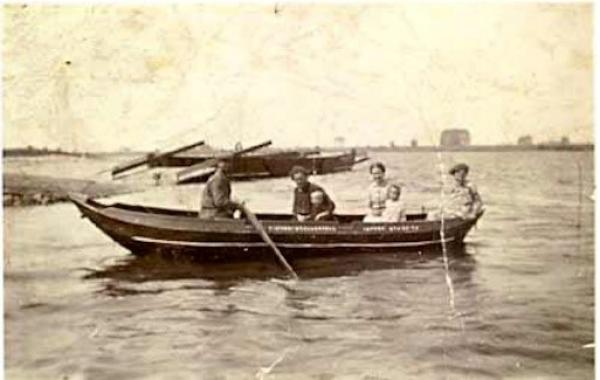
Sapper Harold Magnusson was a crew member along with Sapper Roherty under Corporal Ryan’s command in the first stormboat to cross the Neder-Rijn . Lt Martin was also in the boat to be taken to the far side to co-ordinate the recovery operation. It was initially believed that Sapper Harold Magnusson was killed when his boat was hit by mortar fire on the way across but his body was not recovered immediately after the operation. The other three men in that boat were also killed.
While he was originally described as “Missing in Action” after Operation BERLIN, when Magnusson’s body was later found in the Lek River on 14 November, his cause of death was categorized as “Died While Prisoner of War” and dated 14 November - the day that his body was found. The reason for this category is not explained in the files but may be a misunderstanding of the situation under which Sapper Magnusson’s body was recovered. The finding of his body is a story in itself.
On 14 November 1944, weeks after the operation, two 11-year-old Dutch boys stood on the banks of the Lek River near Tienhoven. In those times of near-starvation for part of the Dutch population, scavenging material that came floating down the river was a necessity. Sometimes objects of value were delivered by the river and recently the boys had found sacks of flour that were partly edible. On this day, they saw something floating in the river and suspected it could be more flour so they rowed out to investigate.
The boys braved the strong current but, instead of discovering more flour, they discovered two bodies. The boys recovered the bodies to the shore and reported the find to the Ferryman who then notified the German occupiers who took care of the bodies. Two coffins were made in Tienhoven and the bodies were laid in the local church for some days before the German Orzkommander gave the order that they had to be buried. The two soldiers were buried in the part of the General Cemetery in Gorinchem that the Germans had commandeered for the burial of their soldiers. The bodies turned out to be a Polish and a Canadian soldier. The Canadian was Sapper Harold Magnusson and the Polish soldier was Paratrooper Czeslaw Gajewnik.
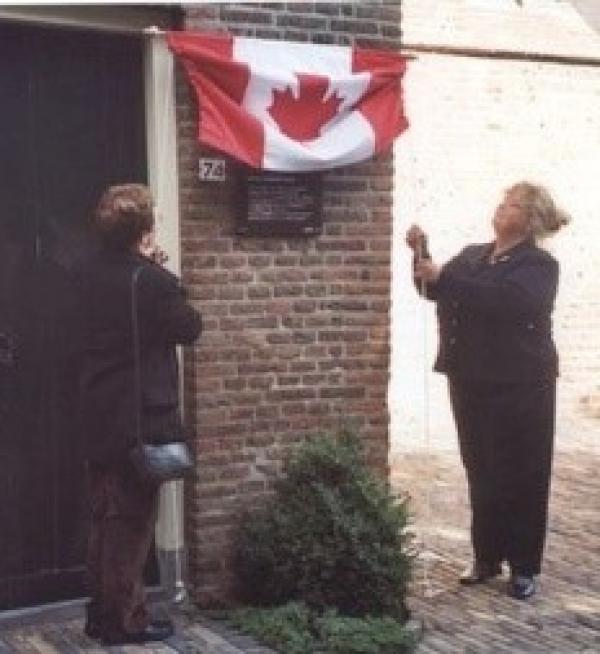 "
"
honouring Spr Magnusson
and Para Gajewnik
Many years later, the curiosity of a Dutch citizen, Alice van Bekkum, was raised as she laid flowers at her parent’s grave in Gorinchem and wondered why this unusual location for a single Canadian grave. This led to her research that produced contact with Sapper Magnusson’s relatives in Canada as well as with the two individuals who had discovered the bodies. Subsequently, the Ameide and Tienhoven Historical Association placed an explanatory plaque on the wall of the church. Two daughters of Sapper Magnusson’s twin sister came to The Netherlands to visit his grave and unveiled the plaque on 14 September 2004. The plaque reads:
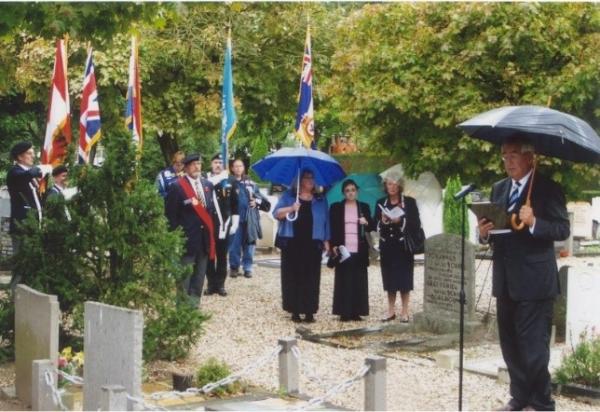
in Tienhoven attended by
Spr Magnusson's nieces
14 September 2004
"In mid-November 1944 the bodies of the Canadian Sapper H.C. Magnusson and the Polish Paratrooper C. Gajewnik were laid out in their coffins in this church. Both were killed in action on the 26th of September 1944 while crossing the river Nederrijn near Oosterbeek. During the Battle of Arnhem. On the 14th of November they were recovered from the River Lek near Tienhoven. They were eventually buried in Gorinchem."
For his service to Canada, Sapper Magnusson was awarded the Canadian Volunteer Service Medal and Clasp, the France and Germany Star, the Defence Medal, the 1939-1945 Star, and the 1939-1945 War Medal.
Prepared by Corporal Christopher Masters of 2 Combat Engineer Regiment of Petawawa, ON and LCol Ken Holmes (Ret’d) with the results of research contributed by Alice van Bekkum of The Netherlands.