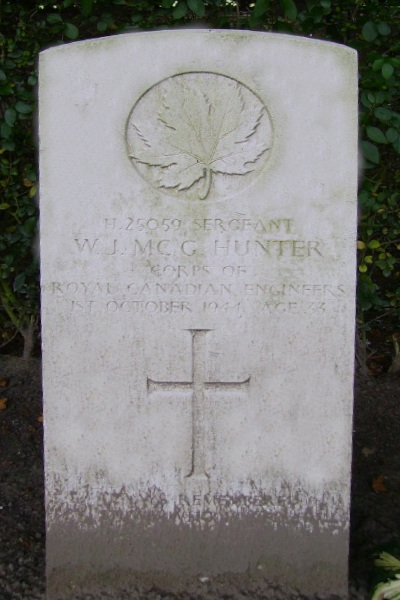
William John McGregor Hunter was born in Killarney, Manitoba, the son of Harry and Kate M. M. Hunter. He was living with his wife in Swan River, Manitoba and employed as a stoker when he enlisted at the Minto Armouries in Winnipeg on 19 September 1939. He was assigned to the 1st Corps Field Park Company, Royal Canadian Engineers.
William trained in Winnipeg until he was posted to Camp Shilo for a month before arriving at A6 Canadian Engineer Training Centre in Camp Dundurn, Saskatchewan at the end of May 1940. He had completed a First Aid Course and was classified as Welder Group ‘B’. He was appointed Lance-Corpora in July. He embarked for the UK in August and disembarked in Glasgow on 5 September 1940 and was sent to the Canadian Engineer Reinforcement Centre where he was employed until late August 1942 when he was taken on strength of the 2nd Field Company as a corporal. He was quickly appointed Acting Lance Sergeant and continued training. He was confirmed sergeant 25 March 1943. He was also trade-qualified Pioneer and Painter by that time and went on to complete advanced training on bridging, small arms and other sapper skills.
The 2nd Field Company spent the better part of two years perfecting their bridging skills and practicing mine lifting and route clearance. Disembarking in France on 6 July 1944, they immediately got to work clearing the routes through Caen, bridging the Orne River and participating in the key battles to close the Falaise Gap. They worked on the approaches to the Seine and participated in operations to cross the river. They then moved on the clearance of the Channel ports. An advanced reconnaissance party from the unit were among the first Canadian soldiers to re-enter Dieppe when it fell on 1 September 1944.
By 10 September, the company was in Ostend, Belgium putting the routes in and out of the port back into operation. By the end of September, they had worked their way forward as far as Antwerp and were preparing for operations to clear the Beveland Approaches as the first step in the Battle of the Scheldt. At some point in the advance, Sergeant Hunter had been commended for bravery.
On the morning of 1 October, 1 Platoon had two sections out to widen a road and clear a minefield. At about 1000 hours, and for no apparent reason, two Teller mines and a string of Hawkins grenades exploded killing Sgt Hunter and mortally wounding Spr Clark. The two soldiers were buried in Antwerp with a small ceremony before the company moved one to support the advance that evening.
Return to Part 5: Tributes to the Fallen Sappers of the Scheldt