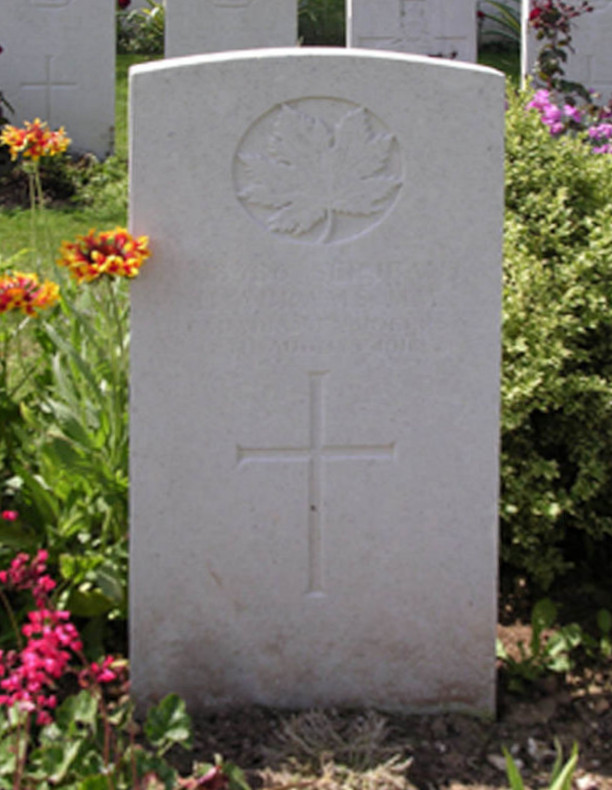
Herbert Abrams was born in 1891 in Kettering, Northamptonshire and emigrated to Canada He worked as a farmer and volunteer fireman and enlisted into the Canadian Army on 11 June 1915 at Niagara Camp, Ontario. He was assigned to the 37th Battalion (Northern Ontario), CEF. (1)
Arriving in England on 11 December 1915 on S.S Lapland, he was appointed to Lance Corporal on 5 February 1916. On 16 May 1916, he was transferred as a Sapper to the 2nd Pioneer Battalion, Canadian Engineers for service on the Western Front with the 2nd Division. He was appointed Lance Corporal again on 28 July 1916, to Lance Sergeant on 16 January 1917 and promoted to Sergeant on 9 April 1917.
Pioneers worked in conjunction with the Engineers in the Forward Area. Pioneer battalions were allocated one per division and had an established strength of over 1000 officers and men. They were not trained as engineers and served as sources of semiskilled labour, often supervised by higher-skilled engineers, but not under engineer command. Their work included tasks consolidating positions captured by the infantry, tunnelling, mining, wiring, railroad work, deep dugout work and laying out, building and keeping trenches in good repair. In 1918, pioneer battalions were broken up with most of the personnel being sent to the newly formed engineer battalions. Herbert was transferred to the 6th Battalion, Canadian Engineers supporting the 6th Canadian Infantry Brigade. (2)
The Hundred Days Offensive was a series of offensive actions by the Allies that finally ended the First World War. Spearheaded by the Canadian Corps, it began with the Battle of Amiens launched on 8 August 1918 when Australian, Canadian, British and French forces opened a 24-kilometre-wide gap in the German lines. German losses were 30,000 men to the Allies 6,500 killed, wounded and missing. The German Commander, Ludendorff called it “the Black Day of the German Army”.
The task of the Sappers was, as always, to maintain the ability of the attackers to live, move and fight on the battlefield. In this case, trenches had to be bridged or filled to allow the 400 tanks along the line to cross over and move forward. Sergeant Abrams, leading his Sappers had already filled two trenches and was bridging a third when he was struck down and seriously wounded in the arms, chest and legs by a shell burst above the trench. He was evacuated to the 6th Field Ambulance, where he died that night.
Before he died, a recommendation for the Military Medal had been submitted The medal was presented to his mother who was still living in his hometown of Kettering She also received a Memorial Medal. His father received a plaque. Sergeant Harold Abrams is buried in Crouy British Cemetery, Crouy-Sur-Somme, France He was 26 years old.
Notes:
- Herbert was one of only a few soldiers from southern Ontario on strength of the 37th Bn. Although it was almost entirely manned with recruits from Northern Ontario, its legacy is perpetuated by The Lorne Scots (Peel, Dufferin and Halton Regiment) in southern Ontario.
- As a means to address increasing manpower shortages in early 1918, the British reorganized their divisions by disbanding the fourth battalion in each brigade and using any surplus to strengthen their remaining three battalions. General Currie took a different approach. He retained the four battalion brigades and used his reinforcements to augment depleted infantry battalions by 100 men. He then created a machine-gun battalion in each division, and expanded each engineer field company (216 strong) to an engineer battalion in each brigade. The help bring the engineer battalions up to strength, each division's pioneer battalion (more than 1000 strong) was integrated into one of the field companies to form an engineer battalion in each brigade. Thus, the 6th Field Company became the 6th Engineer Battalion, CE.
Awarded MM on 09-09-18 (2nd Div Order) Died of wounds 08-08-18 LG date for award is 24-01-19.
There is no citation was created for this award. Sgt Abrams' story is based on research of publicly available documents.
Return to the list of First World War Military Medals