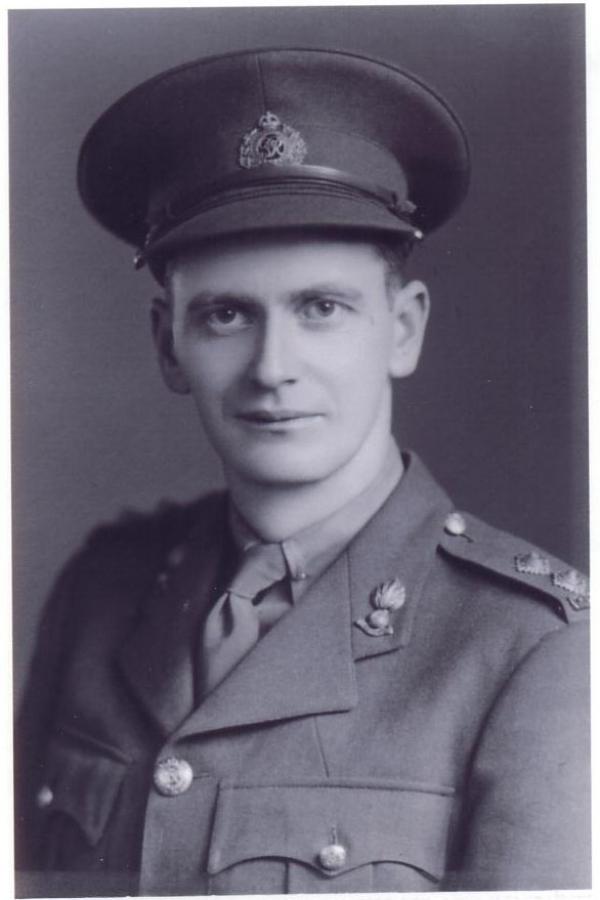
James Russell "Russ" Martin was born on 10 October 1916 on the family farm near the rural village of Bognor, Ontario (near Owen Sound). He was the second youngest child of William and Eliza Martin. Russell, as he was known, had three sisters (Margaret, Bessie and Mary) and three brothers (Willie, Dave and Arthur).
The children attended an 1873 stone one-room schoolhouse located near their home. Russell was a good student and, while this was the Depression Era when few could afford high school, his parents paid room and board for him as the school was too far from home by horse and buggy. Russ completed Grade 13 as the top student and was also a captain in the Meaford High School Cadet Corps.
As was common at the time, all the Martin children spent many back-breaking hours working in the fields on the farm. Russ had no interest in continuing the family tradition of farming and he could not wait to experience the world off the farm. His father worked extra jobs at bricklaying in addition to farming so that Russell could go to university. He enrolled at Queens University in Kingston, Ontario in 1936 and graduated with a Bachelor of Science in Mining Engineering in 1940. While at university, Russell was a member of the Canadian Officer Training Corps (COTC) contingent and worked summers in the mining and construction industries. After graduating from university, Russell worked with the Public Service in construction at Camp Petawawa for one year as Assistant Engineer.
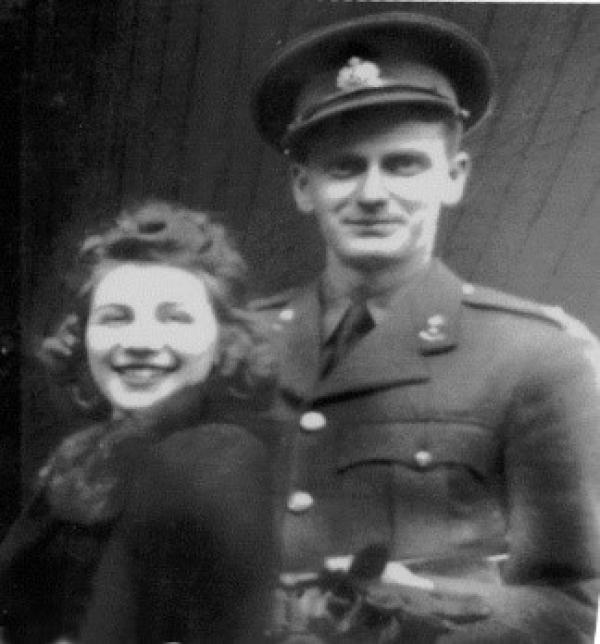
Russel enlisted in the Army on 2 October 1941 and, due to his university schooling and his COTC experience, he was commissioned as a Second Lieutenant. He soon went to the Officer Training Centre (OTC) in Brockville, Ontario to undertake his basic officer training.  During this period, Russell married Erma Leonard, a girl he met during his university days, on 6 November 1940 in Pembroke, Ontario.
Russ was then transferred to A5 Canadian Engineer Training Centre in Camp Petawawa on 17 January 1942 to undergo engineer officer training. Two months later, he was sent back to the OTC in Brockville as an instructor. This was followed by a three-month stint as an instructor at OTC Trois Rivieres in Quebec. Only after these two assignments as an instructor and repeated requests for a posting to a field unit, was he posted to the 23rd Field Company. The company was still undergoing training in Sussex, New Brunswick but soon concentrated in Debert NS with the rest of 2nd Corps Troops, RCE before the unit embarked for England from Halifax, NS on 17 July 1943. In England, they continued training in anticipation of a major role in the invasion of Europe.

23rd Fd Coy from Normandy
to Arnhem
After D-Day, the 23rd Field Company disembarked on the shores of Juno Beach, France on 11 July 1944. The company soon moved into the outskirts of Caen where they were responsible for clearing a roadway through the city of Caen for the Allied advance. Control of the city was still heavily contested and they were regularly under fire as they worked. They cleared a new route through the rubble of wrecked buildings by demolishing obstacles, bulldozing rubble, clearing mines, and filling potholes. After  clearing this route, they supported the Allied advance often by river crossing and bridge-building. They built “Reynold’s Bridge” across the Orne River.
The 23rd Field Company then supported a 4th Armoured Division assault crossing of the Seine River near Pont De L’Arche. The company had trained extensively in England on the use of the British stormboats and the crossing was successful under the occasional artillery and mortar fire. The 23rd Field Company next built a Bailey Bridge across the Seine River in less than 24 hours. The company then supported the Allied advance into Belgium and Holland.

being evacuated from Arnhem
Russell’s company played the major role in Operation BERLIN - the evacuation of the depleted and encircled British 1st Airborne Division on the west side of the Neder Rijn River using the stormboats.
On the night of September 25/26, 1944, Lt Martin volunteered to be the officer in charge of organizing the evacuation of men from the far bank. He was aboard the first stormboat that was launched from the south side of the Neder Rijn across from Oosterbeek. It was believed that this boat was hit by mortar fire. Corporal Ryan and Sappers Magnusson and Roherty were also lost in this storm boat.
Lieutenant Martin was awarded a Mention in Dispatches for his role in the operation. It should be noted that acts of Gallantry as described here usually merited the award of a Military Cross. However, that award was not awarded posthumously. He was also awarded the The Bronze Lion, Order of Orange Nassau with Swords by The Netherlands (see citation below):
“The example set by this officer to his men was outstanding at all times from the landing in Normandy in July 1944 until he was lost on the night of 25/26 September 1944. He was always resourceful and cheerful and his courage under fire won him the complete confidence of all.
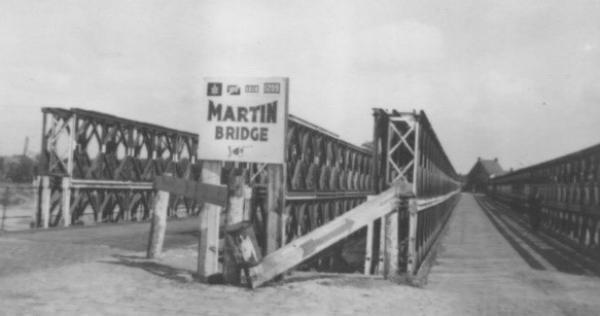
over the Albert Canal in Belgium
remained in place for over 40 years
His leadership is typified in the last action in which he took part. On the night of 25/26 September 1944 his platoon participated in an operation through which over 2,000 survivors of 1 British Airborne Division were rescued from Arnhem. The River Neder Rijn, at the point where the operation took place, was being subjected to intensive mortaring and shelling when the operation was ready to commence. The stretch of riverbank held by the Airborne troops on the far bank was known to be very limited and it was so dark and wet that no signal indicating their position could be seen. Lieutenant Martin begged permission to cross with the leading stormboat so that he might establish contact with the Airborne troops and guide following craft to them. His boat suffered a direct hit and so far as is known there were no survivors. His example, however, inspired others to continue the mission on which he had embarked to a most successful conclusion.”
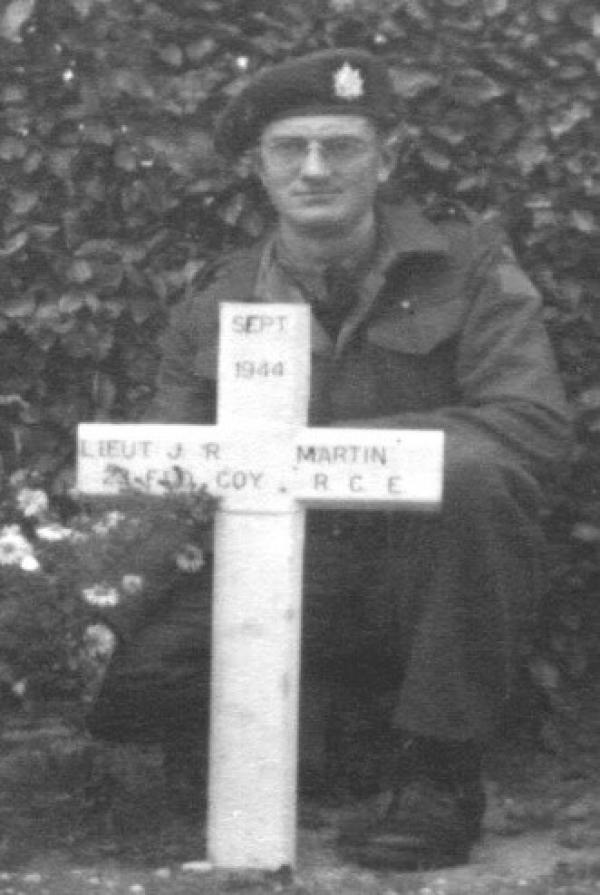
his brother's grave at
Elst in Holland
The 23rd Field Company honoured their fallen comrade when they built their next bailey bridge over the Albert Canal in Belgium and named it the “Martin Bridge”. It stood for 40 years before being replaced with a permanent bridge.
Russell’s body was found a month later and he was buried in a temporary grave in Elst on 24 October. His younger brother, Arthur, fought in Europe as a rifleman with the Queens Own Rifles during the Second World War. Before he returned to Canada, he visited Russell’s temporary grave in Elst Cemetery. Lt. Martin’s remains were moved in 1946 and reburied in Holten Canadian Military Cemetery in Holten, Netherlands.
For his service to Canada, Lt Martin received the Canadian Volunteer Service Medal and Clasp, the France and Germany Star, the Defence Medal, the 1939-1945 Star, the 1939-1945 War Medal and awarded The Bronze Lion, Order of Orange Nassau with Swords from The Netherlands.
Based on the story researched and written by Lieutenant Russell Martin’s great-niece, Cathy Meyers for the Faces-to-Graves project for the Holten Canadian Military Cemetery.