‘Oh, we left Tuft’s Cove in Dartmouth to go to Labrador.
A thousand miles from nowhere on that foggy distant shore.’
....from: 8 Construction and Maintenance Unit song “1942”
The onset of the Second World War presented an immediate need to expand the operations of the Royal Canadian Air Force within Canada and to support the British Commonwealth Air Training Plan (BCATP). A new dedicated organization was necessary as the RCAF Directorate of Works and Buildings could not manage this task.
A new military formation was created that could construct and maintain facilities in areas where using civilian contractors was not economically viable; maintain systems that were beyond the scope of the station/base staff; and construct and maintain entire telephone systems. The organization became known as the Construction and Maintenance Units (CMU).
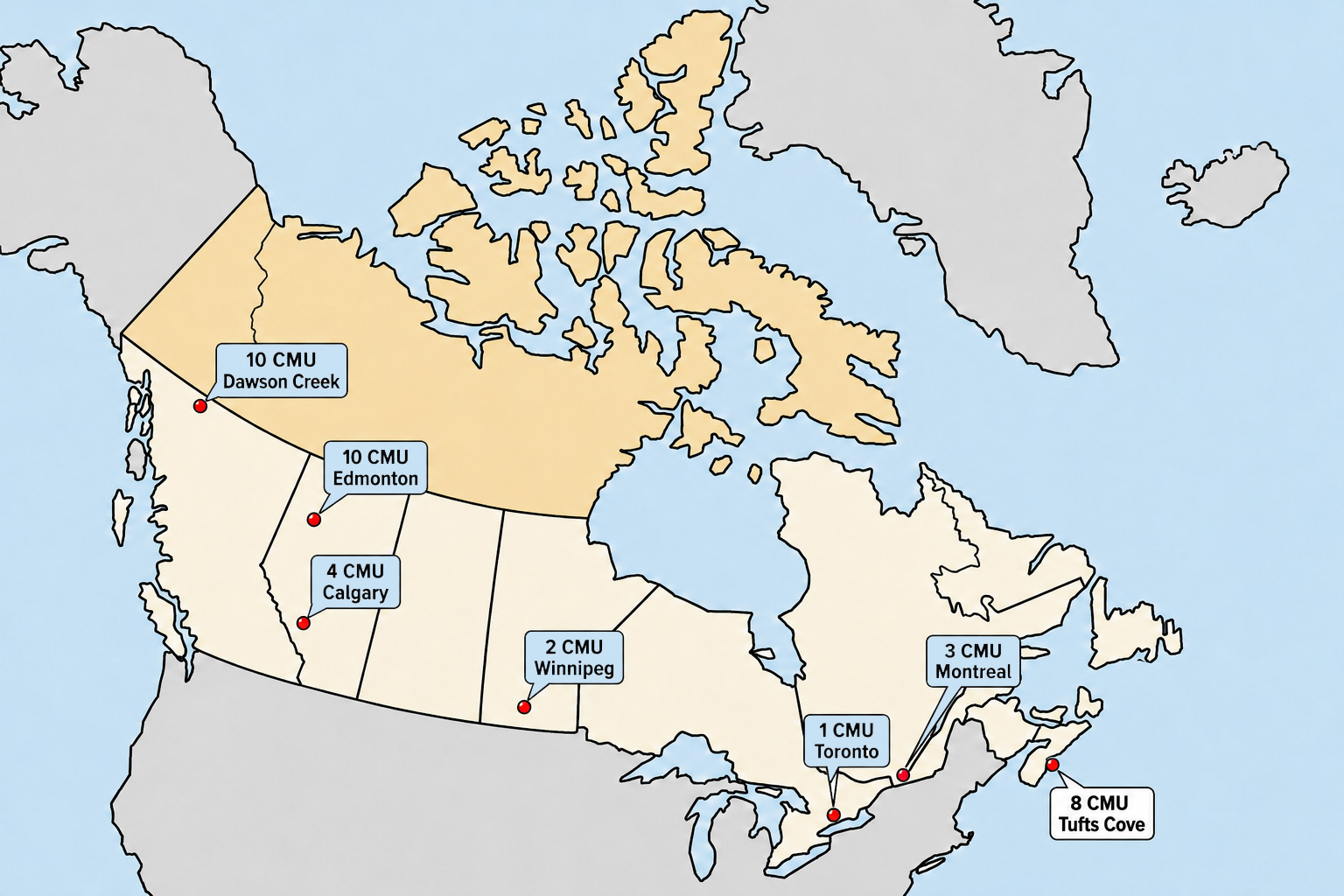
Seven units were stood up: 1 CMU Toronto, 2 CMU Winnipeg, 3 CMU Montreal, 4 CMU Calgary, 8 CMU Tufts Cove, NS and 10 CMU in Dawson Creek and later in Edmonton. Ranging in size from about 400 to 1,650 personnel, their project sites spread from Haida Gwaii to Iceland and from Whitehorse to the US border.
Projects ranged in scope from constructing pigeon lofts to jetties, from erecting radio towers to gantries, and to complete hangers and facilities. Roads and runways were constructed, and hundreds of kilometres of power-pole lines and telephone cables were laid. Often working under adverse weather conditions, at Fontenelle, QC, for example, the work party had to erect temporary accommodations on a mountaintop in seven feet of snow even before the project began.
An illustration of the work undertaken by the CMUs occurred in October 1942 when fifty airmen of 9 CMU constructed a 650 km-long telephone system in remote British Columbia from Williams Lake to Bella Bella. In another, in January 1944, a large group of airmen from 8 CMU was aboard two RCAF ships bound for Iceland to support RCAF 162 Anti-Submarine Squadron. Thirty radar stations were built in remote coastal locations. Fifteen staging sites and emergency runways were built by 4, 9 and 10 CMUs in support of the Northwest Staging Route to Alaska. Three experimental low-frequency radio towers were erected across the Northwest Territories. 1, 2 and 4 CMUs took turns supporting two Ferry Command squadrons in Kapuskasing and Armstrong, ON. 3 CMU built a nutritional laboratory in Montreal. The BCATP requirements on the Canadian prairies kept 2 CMU busy for the duration of the war. The CMUs also occasionally supported the Royal Canadian Navy and the Canadian Army. The headquarters of 8 CMU was five kilometres from the navy’s Bedford Magazine and played a major role in evacuating and sheltering over 2,000 people when that facility exploded on 19 July 1945.
The CMUs were instrumental in the RCAF being able to mobilize and train for the Second World War. The British Commonwealth Air Training Plan in Canada would not have been such an incredible success without the infrastructure that the CMUs delivered at an unimaginable pace. By the end of the war, 4,548 members of the RCAF had served in the CMUs; 25 had died in their service to Canada.