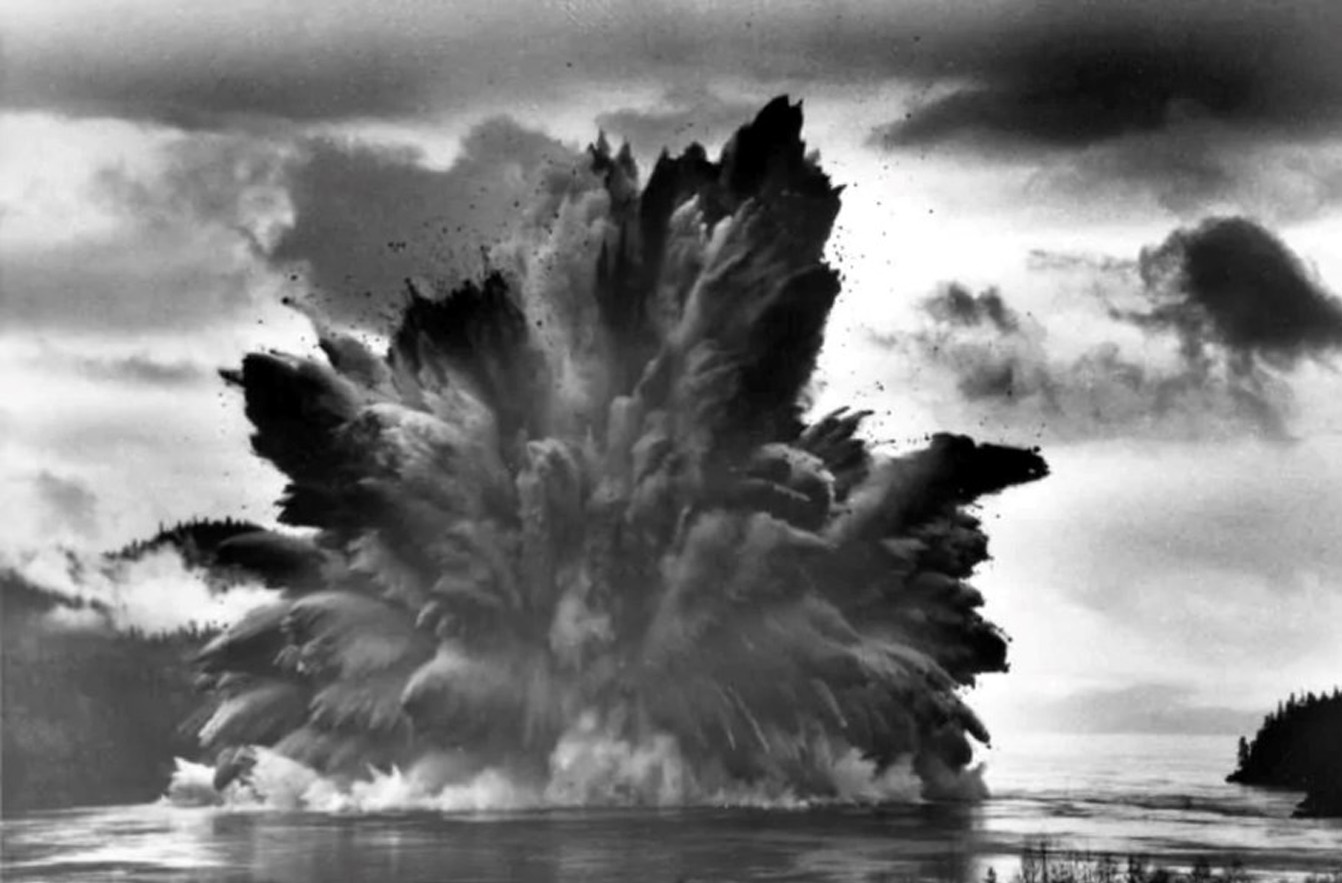
On the morning of 5 April 1958, Canadians gathered around radios and televisions to witness a moment unlike anything they had seen before: the detonation of Ripple Rock in Seymour Narrows, BC. It was, at the time, the largest planned non-nuclear explosion in history. At the centre of this achievement stood Lieutenant Colonel Cyril Burton North (Ret’d), one of the most accomplished and decorated tunnellers the Canadian Engineers ever produced.
North had enlisted in the Canadian Engineers in 1914 and was quickly drawn into the harsh, subterranean world of First World War mining. He soon took command of the 1st Canadian Tunnelling Company at St. Eloi. The sector had already consumed thousands of lives in attacks and counterattacks. When the Battle of Messines opened on 7 June 1917, it was the tunnellers who finally broke the stalemate. Nineteen mines erupted along the ridge; the largest was fired by North’s company. The 95,600-pound blast carved a crater 90 metres across and up to 15 metres deep, clearing the way for the British 41st Division and marking one of the most decisive uses of military mining in the war. Until Ripple Rock, the Messines mines remained the largest planned explosions ever executed.
By 1918, North had been wounded twice and decorated repeatedly: the DSO and Bar, the Military Cross, and five Mentions in Dispatches. After the war, he returned to mining in British Columbia, but the Second World War called on his expertise. He raised and commanded No. 2 Canadian Tunnelling Company, taking them to Gibraltar in 1941. Those miners carved an underground world of roads, storehouses, artesian wells, and a vast hospital. North ended the war as a Lieutenant Colonel and resumed his civilian engineering career.
Ripple Rock in British Columbia was a twin-peaked underwater mountain rising to within nine feet of the surface at low tide. Since the late 1700s, it had been feared by mariners; more than 120 vessels had been damaged or sunk, with at least 110 lives lost. Two wartime attempts to blast it from the surface had failed. In 1953, the National Research Council proposed a tunnelling solution - an approach tailor-made for North.
Cyril North was hired by Dolmage & Mason Consulting Engineers to lead the project. From 1955 to 1958, crews drove a 174-metre shaft down from Maud Island, a 762-metre horizontal tunnel to the base of Ripple Rock, and two 91-metre vertical shafts into its peaks. Into these chambers they packed 1,270 metric tons of explosives.
At 9:31 a.m. on 5 April 1958, the charge fired. More than 635,000 metric tons of rock and water erupted skyward, clearing the narrows to a safe depth and ending one of the most dangerous hazards on the West Coast. It was a triumph of engineering, perseverance, and the quiet professionalism of a Canadian tunneller whose career had shaped history underground - and now underwater.