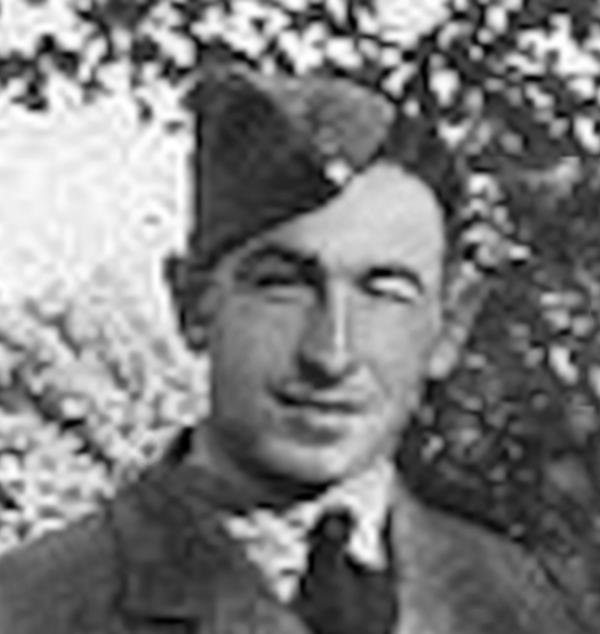
Daniel William Ryan was born in Sydney Mines NS. He left school after Grade IV at the age of 11 and worked as a bricklayer-concrete worker for 16 years when he enlisted on 13 August 1940. He was single and living at home with parents at the time and his brother John was already in the Army.
During the enlistment process, there was an error in the order of his Christian names and his name was initially recorded as “William Daniel Ryan.” This error is often seen on documents in his Service Record File.
Dan was assigned to No. 3 Fortress Company (Electrical and Mechanical) in August and qualified as a Pioneer in November 1941. He qualified as a Bricklayer in June 1942 and remained with No. 3 Fortress Company until 4 June 1943 when he was transferred to the 23rd Field Company. At that time, the company was completing its unit training in Sussex NB in preparation for embarkation for overseas.
Dan embarked from Halifax for the United Kingdom on 16 July 1943. Once in England, the company continued training in anticipation of a major role in the invasion of Europe. He was promoted to Lance Corporal on 6 June 44 and the company embarked for France on 6 July and disembarked in Normandy on 11 July.

through the rubble in Caen
The 23rd Field Company soon moved into the outskirts of Caen where they were responsible for clearing a roadway through the city of Caen. The city was in rubble from heavy Allied bombing and a route was necessary to support the advance. They were regularly under fire as the city was still hotly contested. His company soon moved into the outskirts of Caen where, under fire, they cleared a roadway through the rubble of wrecked buildings by demolishing obstacles, bulldozing rubble, clearing mines, and filling potholes that was vital to the Allied advance. The route became known as Andy’s Alley after Lieutenant A. B. Anderson of Headquarters R.C.E., 1st Canadian Army Troops). After clearing this route, they supported the Allied advance with more river crossings and bridge-building. One of the first bridges was the “Reynold’s Bridge” across the Orne River, named for one their officers, Captain G. G. Reynolds, was had been killed two days before.
The 23rd Field Company then supported a 4th Armoured Division assault crossing of the Seine River near Pont De L’Arche using ‘Storm Boats.’ The company had trained extensively in England on the British stormboats for just such tasks and this assault crossing was successful under the occasional artillery and mortar fire. The 23rd Field Company next built a Bailey bridge across the Seine River in less than 24 hours. The company then supported the Allied advance through Belgium and into Holland.

being evacuated in stormboats
In Holland, the company played the major role in "Operation BERLIN"- the evacuation of the depleted and encircled British 1st Airborne Division across the Neder Rijn River. On the night of 25/26 September, Lance Corporal Ryan, Sappers Magnusson and Roherty crewed the first stormboat to cross the Neder Rhein. Lance Corporal Ryan was in command. It was believed that Lance Corporal Ryan was killed when this storm boat was hit by mortar fire on the way across.
For his service to Canada, Lance Corporal Ryan was awarded the Canadian Volunteer Service Medal and Clasp, the France and Germany Star, the Defence Medal, the 1939-1945 Star, and the 1939-1945 War Medal.
Lance Corporal Ryan is buried in the Allied Plot in the Rhenen Community Cemetery in Holland.
Prepared by LCol Ken Holmes (Ret’d).