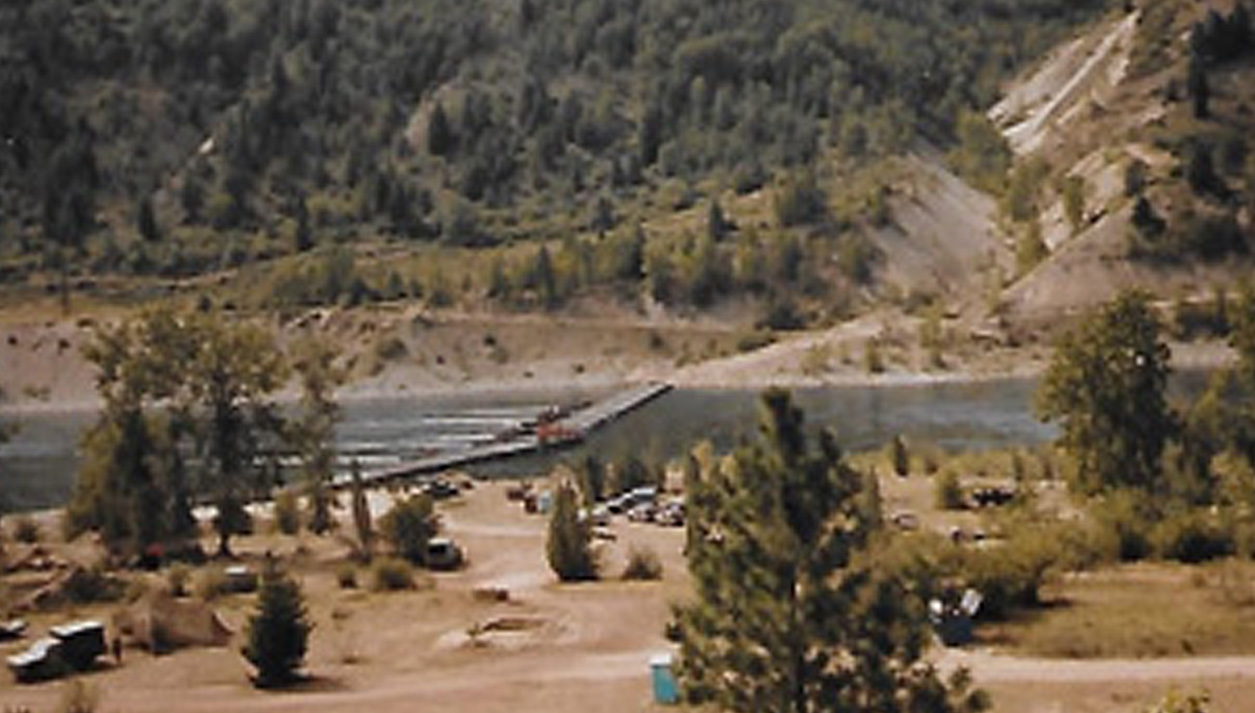
In August 2002, Canadian, American and British military engineers accomplished a remarkable engineering feat near Trail, British Columbia, by constructing a 200-metre Medium Floating Bridge (MFB) across the Columbia River. The 30-bay bridge was the culmination of Exercise Kootenay Castle 2002, a multinational training exercise that demonstrated military engineers' skill, coordination, and ingenuity.
Canadian participants included 1 Combat Engineer Regiment, 8 Field Engineer Regiment, 6 Field Engineer Squadron, 33 Field Engineer Squadron and 44 Field Engineer Squadron. The United Kingdom contributed a troop from 75 Engineer Regiment, Royal Engineers. Participating American units included the 671st Multi-Role Bridge Company, Bridge Company B of the US Marine Corps, the US Army's 14th Engineer Battalion, and 110th Engineer Battalion from the Missouri National Guard.
Planning began in September 2000, with building a crossing of the Columbia River as the major objective. The exercise would include ten days of non-tactical training, followed by a demanding 72-hour bridge gallop involving four bridge builds, three ferry operations and culminating in the construction of the floating bridge.
The United States contingent provided 24 bays of Improved Ribbon Bridge - the American designation for their floating bridge system. Canada supplied the remaining six bays and two Boat Bridge Erection (BBE) boats.
The Columbia River itself was the greatest obstacle. Flowing at more than three metres per second, American military terminology classified the proposed operation as a “wartime-only danger build,” reflecting the hazardous conditions. The river presented serious difficulties for controlling and connecting the floating bridge sections. A solution was negotiated with British Columbia Hydro, which agreed to reduce water releases from two upstream dams near Castlegar for 12 hours. Even with reduced flow, all BBE boats would be needed to manoeuvre the bridge against the current.
Operations began on 21 August at 0500 hours, when Canadian and British engineers, supported by smoke from the US Chemical Corps, crossed the river in assault boats to secure the far bank. By 0600 hours, the first pontoons were entering the water. At 0630, a ferry service began transporting troops across the river. Ferry operations ceased at 0800, and construction of the main bridge began.
Most pontoons were launched from vehicles, but several were delivered by Chinook helicopter. Capturing and controlling these floating sections in the fast-moving river demanded considerable skill and precise coordination among helicopter crews and boat operators. By 1200 hours, the bridge was complete, and vehicle traffic began crossing the Columbia River.
The successful operation demonstrated the value of careful planning, innovative equipment deployment and cooperation between allied military engineering units. It also showcased military engineers' ability to overcome demanding environmental conditions.
Exercise Kootenay Castle 2002 remains a notable example of multinational military engineering in British Columbia, bringing together three nations in an impressive achievement on the Columbia River.