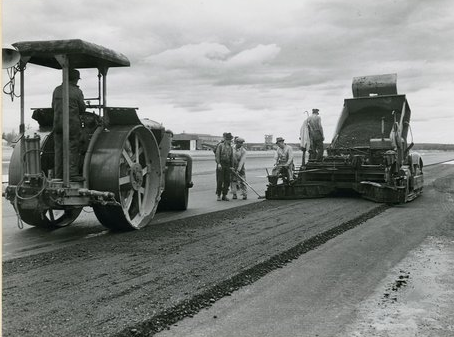
A Second World War Royal Canadian Air Force unit, No. 4 Construction and Maintenance Unit (CMU), was instrumental in developing the North-West Staging Route during the war. This was a vital air corridor connecting Canada to Alaska that was crucial for military operations. Established primarily to ferry aircraft, it enabled the efficient transportation of military material to support operations in the Pacific theatre and to aid the Soviet Union under Lend-Lease agreements.
The North-West Staging Route consisted of eleven airfields: Edmonton (military and civil airports), Grand Prairie, Fort St. John, Beatton River, Fort Nelson, Smith River, Watson Lake, Teslin, Whitehorse, Aishihik, and Snag. Of these airfields, seven were operated by the Department of Transport and three by the RCAF.
Planning for the route began in the 1930s when civil aviation authorities recognized the need for a direct air route connecting Central Canada to Alaska. Following Canada's entry into the Second World War, construction efforts accelerated as the military needs intensified. By December 1940, significant portions of the route were operational, enabling Canada to offer a reliable air corridor to the United States when the United States entered the war. The construction efforts ensured that airports were ready for continuous military operations.
In December 1940, funding was allocated to begin construction, and 4 CMU started work shortly after. The unit's rapid mobilization enabled the establishment of radio ranges and operational aerodromes by early 1941, which were crucial as American forces joined the war effort. These airfields were strategically placed to enable aircraft to operate effectively over long distances, providing critical support for military missions.
The primary contributions of 4 CMU included aerodrome construction and the installation of navigation aids. To enhance the safety and efficiency of air travel, the unit also installed radio ranges and other navigational aids across the route. This infrastructure was vital for guiding pilots through the challenging weather conditions typical of northern Canada.
The North-West Staging Route was a hub of activity throughout the war, with fighters, bombers, and transports operating continuously. The unit's work enabled ferry flights and facilitated responses to threats from Japan on the West Coast. Of the 14,000 Aircraft delivered by the United States to the Soviet Union, nearly 8,000 were delivered via this route.
After World War II, the North-West Staging Route remained a vital air corridor for military and civilian aviation. The infrastructure established by No. 4 CMU laid the groundwork for ongoing air service in northern Canada, effectively ending its isolation.
The contributions of No. 4 CMU were vital in establishing and maintaining the North-West Staging Route during World War II. Their work not only supported immediate wartime logistics but also had lasting impacts on civil aviation in Canada post-war. The strategic importance of this air corridor remains a significant chapter in both Canadian aviation history and military logistics during one of history's most tumultuous periods.