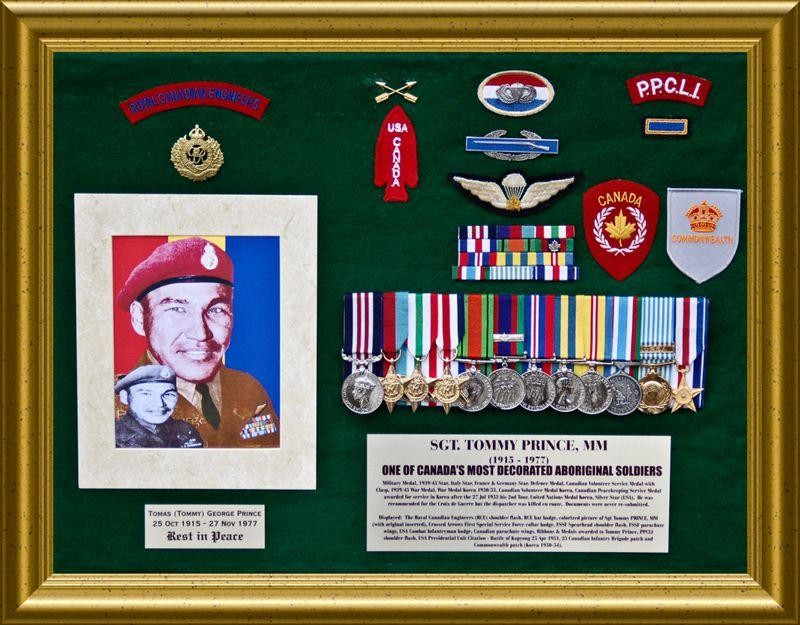
Thomas George Prince was one of 11 children born to Henry and Arabella Prince of the Brokenhead Band at Scanterbury, Manitoba. As a boy, he tracked and hunted. He was an excellent shot with a rifle. He attended the Elkhorn Indian Residential School, where he completed grade eight. He worked as a labourer and spent time with the Army cadets as a teenager.
On 3 June 1941, Prince enlisted as a sapper in the 1st Corps Field Park, Royal Canadian Engineers in Winnipeg. After only a brief training period in Canada, the company left Winnipeg and arrived in England in August 1940. They found themselves deeply involved in hut, road and defence works construction tasks as part of the Canadian Army's contribution to the defence of Britain. This was not what Tommy Prince was looking for when he enlisted, so when the opportunity came in October the following year, Lance Corporal Prince volunteered to serve as a private in the 2nd Canadian Parachute Battalion 1. He completed parachute training in Ridgeway, England and returned to Canada. In December 1942, was selected for the 1st Canadian Special Service Battalion and promoted to Acting Sergeant. The battalion was integrated into the First Special Service Force, training first in Helena MN and then serving in the Italian Campaign and into France. The First Special Service Force was disbanded in December 1944 in the town of Melton on the Italian-French border and its members were scattered among other battalions.
When the fighting in Southern France was over, Prince was summoned to Buckingham Palace, where King George VI decorated him with both the Military Medal and, on behalf of the president of the United States, the Silver Star with ribbon. Tommy Prince was one of 59 Canadians who were awarded the Silver Star during the Second World War. Only three of this group also possessed the Military Medal. The war in Europe ended while Prince was in England. He was one of three Canadians to receive both the Military Medal and the Silver Star during the Second World War. He received the Military Medal from King George VI at a ceremony at Buckingham Palace.
After the war, Sgt Prince ran a business in Winnipeg until rejoining the Army in 1951. He served with the 2nd Battalion Princess Patricia's Canadian Light Infantry (PPCLI) at Kapyong in 1951, and on a second tour in 1952 with the 3rd Battalion at 'The Hook', during which time he was wounded. He was released in 1954 on medical grounds (arthritis in knees).
Sgt Tommy Prince died in died on 25 November 1977 at Deer Lodge Hospital in Winnipeg at the age of 62. He was buried in Brookside Cemetery.
Notes:
The 2nd Canadian Parachute Battalion was designated as such for administrative purposes. The name was a cover for a special force to conduct covert sabotage and demolition work in Norway.
References:
Veterans Affairs Canada, Tommy Prince
Bruce Forsyth, Tommy Prince: Canada’s most decorated aboriginal soldier of WWII
Military Medal
While in action against the enemy near Littoria, Italy, on the 8th February 1944, Sergeant Prince, acting alone, ran a telephone wire from our lines fifteen hundred yards into enemy territory to a house in which he established and maintained an artillery observation post for twenty-four consecutive hours. From his position Sergeant Prince was not only able to observe enemy artillery emplacements invisible from our lines, but was also directly responsible for the complete destruction by artillery of four such enemy positions which were causing considerable damage to our own troops and material.
At one part of his twenty-four hour watch, Sergeant Prince's communications were cut by shells. Using his own ingenuity, Sergeant Prince donned available civilian clothes and, under direct enemy observation, went out to repair his line to re-establish contact for target observation.
Sergeant Prince's courage and utter disregard for personal safety were an inspiration to his fellows and a marked credit to his unit.
Silver Star (US) 1 - 3 September 1944
For gallantry in action near Les Escarene, France, 1-3 September 1944. In charge of a two-man reconnaissance patrol, Sergeant Prince led it deep into enemy-held territory, covering rugged, rocky mountains to gain valuable and definite information of the enemy's outpost positions, gun locations and a bivouac area. So accurate was the report rendered by the patrol that Sergeant Prince's regiment moved forward on 5 September 1944, occupied new heights and successfully wiped out the enemy bivouac area. The keen sense of responsibility and devotion to duty displayed by Sergeant Prince is in keeping with the highest traditions of the military service and reflects great credit upon himself and the Armed Forces of the Allied nations.