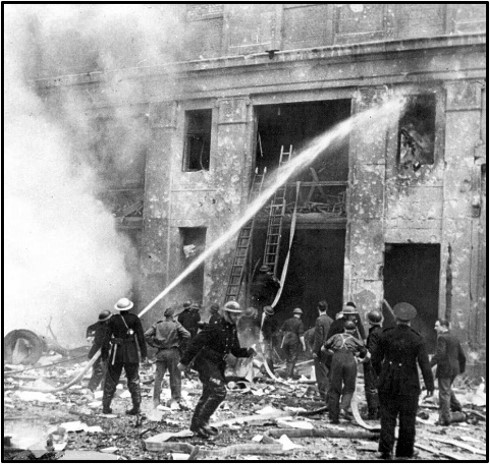
Canada’s wartime engineering story is often told through the lens of the Combat Engineer. Yet in 1941, another uniquely Canadian formation stepped forward - civilian in status, paramilitary in structure, and unmistakably operational in spirit. The Corps of Canadian Firefighters, raised at the request of the United Kingdom during the height of the Blitz, stands as one of the more unusual and least remembered Canadian contributions to the Allied war effort.
The Corps emerged after Prime Minister Mackenzie King’s 1941 visit to Britain, where the scale of destruction from German air raids was unmistakable. Canada agreed to supply a full contingent of trained firefighters to reinforce the United Kingdom’s overstretched National Fire Service. Their commanding officer, G.E. Huff, MM, embodied the Corps’ hybrid identity. He was a former Royal Canadian Air Force fire prevention officer who secured release from the Air Force specifically to lead this new formation.
Recruiting began in March 1941 and quickly drew more than 400 volunteers from more than a hundred municipalities across every Canadian province. By December 1941, 406 members had deployed overseas.
Upon arrival in Britain, the Canadians underwent a four week program in firefighting, rescue, and drill before being posted to the major urban centres of Southampton, Portsmouth, Plymouth, Bristol, and London. Their work was immediate and dangerous as they responded to fires triggered by bombing raids - often under continued attack. During the February 1943 raids on London, the unit came into action both in firefighting and rescue operations, and its performance was highly commended. Casualties were surprisingly low, though luck played its part. One detachment was out fighting fires when a bomb destroyed their accommodations.
In 1944, the Corps prepared a special service company of 101 volunteers to support Army Fire Services during the Normandy campaign. Although ultimately not deployed, the episode demonstrated the Corps’ willingness to operate forward, shoulder to shoulder with combat engineers and other troops.
Recognition for the Corps came both during and after the war. Decorations included an OBE for Commanding Officer Huff, an MBE for Senior Company Officer N. Torno, and British Empire Medals for several others. Acts of lifesaving outside normal duty were also honoured, including Royal Humane Society and Royal Society testimonials.
Three members of the Corps lost their lives during service. Their names were later added to the United Kingdom Firefighters National Memorial at St. Paul’s Cathedral: J.S. Coull, A. Lapierre, and L.E. Woodhead.
Sir Aylmer Firebrace, Chief of Staff of the National Fire Service, offered perhaps the most succinct assessment of the Corps’ legacy: “Efficient firemen of fine type and first-class physique, they have made a thoroughly good impression over here.” Their service - technical, courageous, and humanitarian - stands as a distinct chapter in Canada’s wartime engineering heritage.