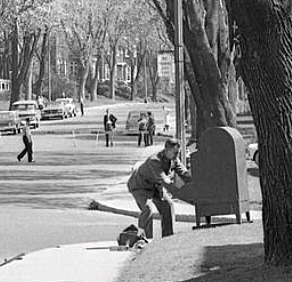
During the late 1950s and early 1960s, the Front de libération du Québec (FLQ) escalated the political violence in Quebec as it turned to bombings to advance its separatist cause. In the spring of 1963, the tempo of attacks increased sharply, and the Canadian Forces became involved.
Quebec Command was tasked with assisting civil authorities, and individuals were placed on standby to support civilian police with bomb disposal. One of these individuals was Warrant Officer Class II Walter “Rocky” Leja, the Regimental Quartermaster Sergeant of 3rd Field Engineer Regiment, Royal Canadian Engineers.
Walter was a Veteran of the Second World War. Born in Poland, Walter had arrived in Canada in 1935 as a 16 year old orphan. Six years later, he enlisted for the Second World War with the 7th Canadian Reconnaissance Regiment (17th Duke of York Hussars).
After training in Canada, Walter embarked for the United Kingdom in July 1941. Landing in Normandy on 11 June 1944, he fought with his regiment from the Battle of Normandy to the final advance into the northern Netherlands. He remained in Europe with the Canadian Army Occupation Force until after Christmas 1945.
Walter reenlisted in the Militia in 1951, joining the 3rd Field Engineer Regiment. He trained in explosive ordnance disposal. By 1963, he had risen to Warrant Officer Class II (WO II) and was the Regimental Quartermaster Sergeant. Walter became one of the regiment’s designated bomb disposal experts.
At approximately 3:00 AM on 17 May 1963, five bombs detonated in Westmount mailboxes within twenty minutes. Police suspected there were additional devices and requested military assistance. WO II Leja and Lieutenant H.D. Simpson, the Regular Force Support Staff Officer, were dispatched to support the investigation.
Inside the first suspicious mailbox was a package that could not be identified - even with a stethoscope. After discussing options, the team attempted to move the entire mailbox using a fire department ladder truck. When the box toppled, Leja - fully aware of the risk - reached inside, removed the suspected bomb by hand, and carried it to an open field.
The second mailbox was located in a dense residential area. Leja confirmed the presence of a live device wired for electrical detonation. With complete disregard for his own safety, he dismantled it.
The third mailbox contained a bomb of the same design. Walter began neutralizing it. As he cut one of the wires, the device exploded and grievously injured him. Against all expectations, he survived but lived the next twenty nine years in hospital.
For his “conspicuous courage and outstanding devotion to duty,” Walter Leja received the George Medal from Governor General Georges Vanier in March 1964.
“Rocky” Leja’s story is one of quiet resolve, professional mastery, and a level of courage that would ultimately cost him dearly. Walter Leja embodied the highest ideals of service. An immigrant who chose Canada, he ultimately gave up nearly all of himself to protect the lives of fellow citizens. His story reminds us of the cost of courage - and of the quiet heroism that often stands between danger and the public it threatens.