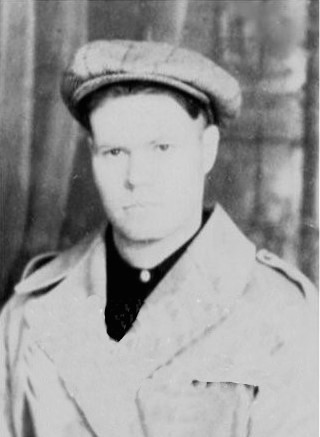
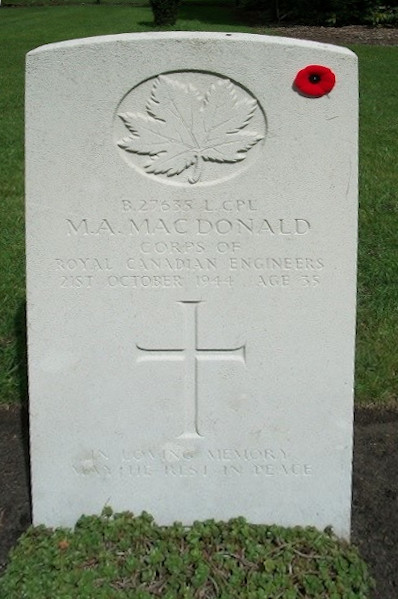
Lance Corporal Murdock Alexander MacDonald was born in Inverness, Nova Scotia, to John and Catherine MacDonald, the first of six sons. He left school at age 13 and worked cutting pulpwood every winter and on the family farm in Mabou, Nova Scotia during the summer months.
In 1935, he moved to Halet in northern Quebec and worked five years as a hardrock driller and shaft worker at the Goldfield Mine. He enlisted in Timmons, Ontario on 22 June 1941 and requested to serve in the Royal Canadian Engineers. He did not know how to drive nor did he have any mechanical experience at that time. Two days later, he began his sapper training with the 8th Field Squadron, first at Camp Dundurn, Saskatchewan and later at Camp Debert in Nova Scotia. He was qualified as Pioneer Group ‘C’ in June 1942 when the Squadron arrived in the United Kingdom as part of the 4th Canadian Armoured Divisional Engineers.
The 8th Field Squadron took up residence at East Horsley, 20 miles southeast of London. For two years, they moved about England building Bailey bridges, training on mines and booby traps, building fortifications and cleaning up damage from German bombs and V-1 rockets. In late July 1944, they arrived in France using the artificial harbour at Arromanches with other elements of the 4th Armoured Division.
Their first task was clearing rubble in Caen while being continually shelled by German artillery. In early August, they were part of Operation TOTALIZE, one of the last battles in Operation OVERLORD and the first for the newly formed 1st Canadian Army with sections riding in half-tracks to keep up with the tanks as they followed a massive creeping barrage. Their task was to build tank positions at Falaise to cut off retreating German forces. After that, they built rafts on the Seine and were the first Canadian engineers to cross over the river.
The Squadron then cleared routes to the Somme and at Pont Remy, on 3 September, built the Ward Bridge, a 90-foot Double-Single, named for one of their officers, Lt John Ward who had won a Military Cross a few weeks earlier. After the Somme, they were in Belgium leading the 4th Division advance to the Rhine through the Low Countries. Among their first tasks was bridging the Leopold and Ghent Canals with a 300-foot Bailey bridge under fire most of the time. They continued forward, bridging, repairing routes and lifting mines.
The Battle of the Scheldt began on 2 October. The 4th Armoured Division pressed forward in flooded terrain, not at all suited for tanks, forcing them to stay on the roads. They built a floating bridge over the Derivation Canal on 5 October and on 12 October were engaged in the Breskens Pocket supporting the Canadian Scottish Regiment by building a Bailey bridge as the infantry fought hard along a disputed roadway. By 20 October, the 4th Division had crossed the Antwerp-Turnhout Canal on an 8th Field Squadron bridge.
Three weeks into the battle, largely supporting the 3rd Infantry Division’s assault over the Leopold Canal and into the Breskens Pocket, the 4th Armoured Division moved north to support the 2nd Infantry Division’s assault into the Beveland Penninsula. The Engineers were tasked with clearing the heavily mines and obstacled approach routes from Antwerp to the start line on the South Beveland Canal.
On 21 October, the leading field troop faced eight roadblocks on the route, averaging 200 feet in length with at least 20 felled trees in each one. Every third tree was booby-trapped with artillery shells and Teller mines wired from branch to branch. The sappers were constantly under fire from machine guns, small arms and 20-millimetre cannon as they worked. They lifted Schu mines, R mines, and a 50-kilogram bomb. When a booby-trapped railway gate on the route was pulled open, the explosion killed Lance Corporal Murdock MacDonald, Sapper McCaw and Sapper Trihart, and wounded two others.
Lance Corporal Murdock Alex MacDonald was first buried in a nearby churchyard in Belgium and later moved to the Canadian War Cemetery at Bergen-Op-Zoom in The Netherlands. He was 35 years old.
Note: Murdock’s younger brother, Leading Aircraftsman Donald MacDonald, also served overseas in the Second World War with the Royal Canadian Air Force.
Return to Part 5: Tributes to the Fallen Sappers of the Scheldt