Walter Rolland "Rocky" Leja, GM, CD was born in Koniówka, Poland. He came to Canada in 1935 as an orphan bringing his younger sister with him when he was 16 years old. They landed in Halifax and moved on to settle in Montreal. and in March 1941. He enlisted in the 7th Canadian Reconnaissance Regiment (17th Duke of York Hussars) in Montreal.
After a short period of training in Camp Borden, he was sent to the UK to join the rest of his regiment that July. The 7th Recce Regt landed in Normandy on 11 June 1944 and joined the 3rd Canadian Division. Rocky saw action through the Battle of Normandy, the Crossing of the Seine, the Clearing the Channel Ports, the Scheldt and up to the surrender of Germany in the northern Netherlands. He stayed on in Holland and Germany as part of the occupation force only returning to Canada after Christmas in 1945. Walter received his Canadian citizenship in December 1946, shortly after his marriage to Sophie in Montreal. They had one daughter.
Walter reenlisted in the Canadian Army (Militia) in 1951. He served in 3rd Field Engineer Regiment, Royal Canadian Engineers based in Westmount and trained in explosive ordnance disposal. By 1963, he had been promoted at Warrant Officer Class II and assigned a Sergeant Major's position.
This extract from History of the Canadian Military Engineers, Volume III, sets the scene for the event that would change Walter's life forever
Despite the relative stability experienced during the decade 1955-1965, political unrest was developing in the province of Quebec, led by the Front de Liberation Quebecois (FLQ) which espoused the separation of the province of Quebec from Canada. To confront the increasing threat of violence, military forces in Quebec Command were tasked to assist the civil authorities in countermeasures and also to secure military facilities. Qualified individuals were placed on standby to assist the military and civilian police forces with bomb disposal.
In spring 1963, FLQ threats and terrorist actions escalated and climaxed in a series of bombings in the province of Quebec. Shortly after 0300 hours on Friday 17 May 1963, five improvised bombs exploded in mailboxes within a 20 minute period in Westmount, a city within Greater Montreal. The police suspected additional mailbox bombs and requested army bomb disposal assistance. In response, Quebec Command tasked two soldiers from 3rd Field Engineer Regiment to provide bomb disposal assistance; WOII W.R. Leja, the Regimental Quartermaster Sergeant (RQMS) and the unit's Regular Force advisor, Lt H.D. Simpson. They proceeded to the sites where mailbox bombs were suspected and were assisted there by the police.
Walter was able to dismantle two of the mailbox bombs he found, but the bomb in the third mailbox exploded. It blew off most of his left arm and crushed his face and chest. He suffered severe brain damage, lost the ability to speak and was paralyzed on his right side. Despite early reports that his chances of survival were extremely thin, Walter showed the fortitude that had always characterized this resolute soldier. With a stoic resolve that many will find difficult to contemplate, spent the next twenty-nine years in hospital living out the remainder of his life. The day following the event, a trust fund that reached $30,000 (close to $300,000 in 2020 dollars) was set up for Walter. Members of 3rd Field Engineer Regiment visited Walter regularly and especially on 11 November, Remembrance Day.
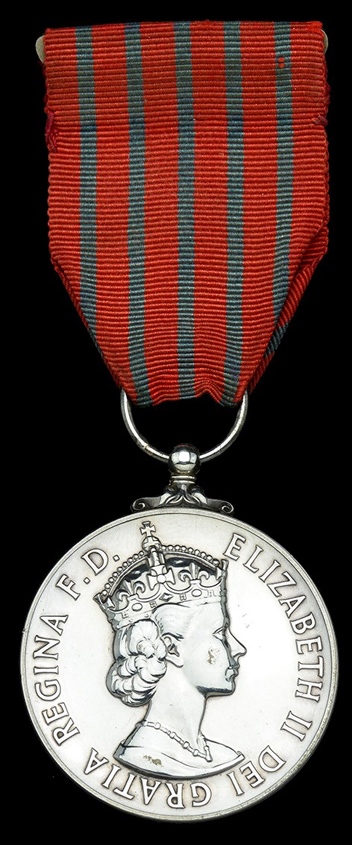
Walter’s bravery, conspicuous courage and outstanding devotion to duty won him the George Medal which was presented by the Governor-General, General Georges Vanier, OBE, MC and Bar, a soldier himself, the following March.
Jean-Denis Lamoureux, a member of the FLQ who participated in the planting of the bombs, was subsequently jailed.
In 2013, the Quebec National Assembly declared an official “Hommage” citing Leja’s “most selfless acts”.
By any standard, Walter Leja was a true Canadian hero. He relinquished his being so as to protect average citizens and, in a sense, a way of life that he, as an immigrant, had personally selected. Clearly, a moment of reflection is due.
Return to George Cross and George Medal Awards
Within the past few months, terrorist group activities in the Montreal area have resulted in a great deal of tension and anxiety for both the civilian population and military personnel. In order to assist the heavily taxed police authorities in the disposal of terrorist bombs, teams of military demolition experts were formed. Regimental Quartermaster-Sergeant (WO 2) Leja was one of these experts. Between 0300 and 0320 hours on Friday 17 May 1963 in the City of Westmount, bombs exploded in five postal boxes. A subsequent inspection of postal boxes throughout the city resulted in the finding of suspicious looking packages in several others. As a result, assistance was requested from the Army. R.Q.M.S. Leja and an officer responded to the call. The first mail box which they examined was located near a large school which made it imperative to neutralize or remove the bomb, if one existed. The box contained a package which had the appearance of a possible bomb. R.Q.M.S. Leja examined the package with a stethoscope but could not make positive identification of its contents by this means. The Warrant Officer then volunteered to dismantle the package to the point where it could be determined if it was in fact, a bomb. After a discussion as to the various courses of action which could be taken, it was decided to move the postal box intact across the street to a vacant field by means of a hook attached to a fire department aerial ladder truck. In carrying out this manoeuvre, the postal box was knocked over and realizing that if the bomb exploded several persons would be killed or injured, he picked the bomb out of the mail box and carried it, by hand, to the open field. After having laid it on the ground, he started to walk away from it, but, after a step or two, he went back to the bomb, picked it up again and placed it behind and at the base of a large tree in a screened position to minimize the blast effect if it exploded later. They then proceeded to the next postal box which was located in a built up area of the city which meant that a bomb would have to be destroyed in situ if it could not be made safe. On determining that the package in this box was a bomb, R.Q.M.S. Leja, fully realizing the danger involved and with complete disregard for his own safety, coolly proceeded to dismantle it. This bomb had also been fixed to be fired electrically using several sticks of dynamite as the lethal force. They then proceeded to the third mail box which, on examination, revealed a bomb of the same type as the one previously dismantled. This Warrant Officer immediately attempted to neutralize it, using the same technique which had been successful in disarming the previous one. However, as he was cutting one of the wires, it exploded, critically injuring him and leaving him maimed for life through the loss of his left forearm, severe brain damage and other serious injuries from which there is little hope of any appreciable recovery. During this ordeal, R.Q.M.S. Leja displayed conspicuous courage and outstanding devotion to duty. His action in addition to inspiring and reassuring those who were required to be near him, clearly showed that his concern for the safety of others was far greater than for his own.
Return to George Cross and George Medal Awards