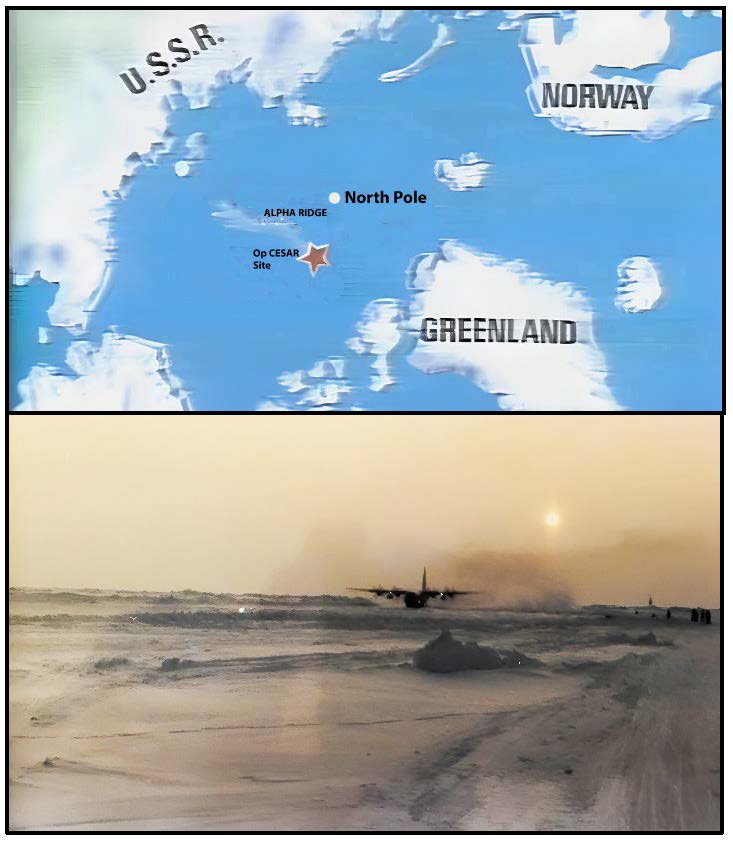
A remarkable military operation known as Operation CESAR took place in Canada’s far North in March 1983. This mission involved a daring airborne drop by 2 Combat Engineer Regiment (2 CER) onto the polar ice near the North Pole. The operation aimed to create an ice runway to support scientific research on the Alpha Ridge - a submerged mountain chain that stretches from Ellesmere Island to the Siberian continental shelf. The operation was crucial for determining whether this ridge was an extension of Canada's continental shelf, which would affect international resource rights in the region.
The planning for Op CESAR began in 1981, spearheaded by Major Dave Noble's 2 CER team. The first challenge was to identify practical methods to reduce pressure ridges in ocean ice using explosives. Master Warrant Officer Doug Neale and Sergeant John MacPherson conducted reconnaissance missions near Resolute Bay to devise a strategy. Their recommendations led to meticulous preparations, including the unprecedented trial drop of a WABCO road grader from a C-130 Hercules aircraft.
As the date approached, the team faced extreme weather conditions, with temperatures plummeting to -72°C and heavy snow complicating their efforts. Despite these challenges, they successfully identified a suitable drop zone approximately 600 kilometres from the North Pole, where the ice thickness reached up to two meters.
On 15 March, four CC-130 Hercules aircraft departed from Thule, Greenland, carrying essential equipment and personnel. The mission was fraught with complications; one aircraft had to divert due to mechanical issues, while another faced fire warnings. However, the main drop proceeded successfully three hours after take-off, with all heavy equipment and 17 members of 2 CER parachuting onto the ice.
Upon landing, the team quickly set to work constructing the 100 x 5000 ft runway, with Capt John Hampson leading on-site operations. The initial steps involved clearing the snow with dozers and using explosives to break up the pressure ridges that crisscrossed the designated runway area.
After levelling the surface with graders, they flooded it with seawater to create a smooth landing area. Work culminated on 24 March when the first of 35 Hercules aircraft landed at Camp CESAR. Over the next month, the team successfully facilitated numerous landings to support data collection for this scientific research.
Op CESAR was a success whose significance extended beyond its immediate objectives. The data collected contributed to Canada's submission to the United Nations Convention on the Law of the Sea, which aimed to define our continental shelf boundaries in both the Atlantic and Arctic Oceans. This submission was pivotal in asserting Canada's sovereignty over its northern territories.The teamwork displayed by military engineers and scientists under extreme conditions is a testament to Canada's enduring spirit in safeguarding its sovereignty and advancing knowledge about its natural resources.