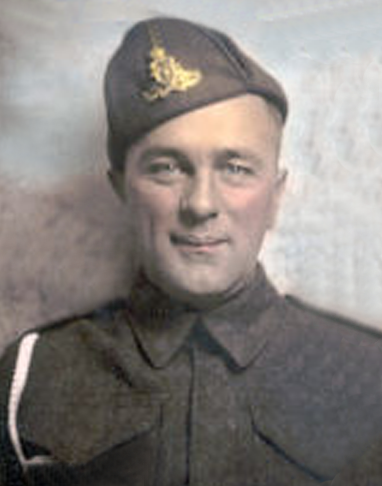
Ronald Tracy McKee was born on 2 April 1908 in St. Martins, New Brunswick. The youngest of a family of seven children, Ronald had three brothers (one of whom served overseas) and three sisters. He grew up in a farming community and went to school in St. Martins, NB but left school at age 14 after Grade 7. He was working as a labourer when he enlisted on 15 June 1940 in St John, NB. Ronald was assigned to the Royal Canadian Artillery with the 15th Heavy Battery of the 3rd (NB) Coastal Brigade.
Ronald had experience as a truck driver and owned a car and was soon headed to No. 7 Vocational Training School in Woodstock, NB where he completed a three-month Motor Mechanics Course. After two years with the artillery, he was transferred to 23rd Field Company, Royal Canadian Engineers on 2 June 1943. He joined the unit in its last few months of training in Canada at Sussex, NB and embarked for the United Kingdom out of Halifax on 16 July 1943. He became known in the unit by the nickname 'Buck' apparently as he had been a very successful deer hunter.
The company continued training in England in preparation for the planned invasion of Europe. During this time, he completed a 10-day Driver Wheeled course at No.1 Canadian Engineer Reinforcement Unit in November 1943.
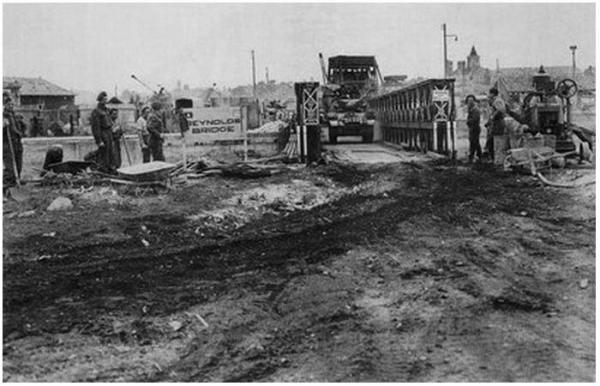
23rd Fd Coy in Caen
As a Corps Troops unit, the 23rd Field Company was assigned as follow-on troops after the D-Day landing at Normandy. On 11 July 1944, they disembarked on the shores of Juno Beach, France. Sapper McKee was Lieutenant Russ Kennedy’s driver.
The company soon moved to the outskirts of Caen where they started to construct a new roadway nicknamed “Andy’s Alley” for the Allies’ advance through the heavily bombed city. They were regularly under fire while they were bulldozing and removing rubble, clearing mines, demolitions and filling potholes. The 23rd Field Company continued their road construction until the end of August when they started to get involved in water crossings and bridge-building. They were assigned to support the 4 th Armoured Division assault crossing of the Seine River near Pont De L’Arche. His company had trained extensively in England on the use of the British Stormboats with 50-horsepower outboard motors. The crossing was successful under the occasional artillery and mortar fire. After the crossing, the company continued to ferry Allied Forces until the end of August. Their next task was to construct a Bailey Bridge across the Seine somewhat downstream of Bassin de l'Orne The company named the bridge after Captain G. G. Reynolds who was killed two days earlier in Vaucelles. The company then supported the advance into Belgium and Holland up until Operation MARKET GARDEN.

23rd Fd Coy from
Normandy to Arnhem
Operation MARKET GARDEN aimed at seizing nine bridges with combined U.S. and British airborne forces (Market) followed by land forces swiftly following over the bridges (Garden). The 1st British Airborne Division’s assault aimed to capture the major Rhine River bridge at Arnhem. The operation had failed to achieve the objective and, after an 8-day battle, most of the division was either killed or captured.
An operation, code-named Operation BERLIN, was soon set in motion to rescue the trapped airborne troops. It was carried out by two Royal Canadian Engineer Companies (20th and 23rd Field Companies) and two Royal Engineer Field Companies (260th and 553rd Field Companies) and set for the night of 25-26 September 1944. Among the infantry providing support to the Canadians were members of the US 206th Parachute Infantry Regiment, made famous in the miniseries drama, Band of Brothers. The Canadian units were equipped with stormboats whereas the Royal Engineers were equipped with assault boats.

being evacuated during Op Berlin
In dismal conditions and under the constant fire and the German bombardment with artillery and mortar fire, the boats shuttled back and forth across the wide swift river through the night. In the end, about 2500 of the 10,000 airborne troops were able to escape across the Neder Rijn (Lower Rhine), 90% of them being extracted by the 23rd Field Company. This was, however at the cost of seven men killed and missing.
Spr McKee was assisting in moving the stormboats from the trucks to the river when he was hit by shrapnel. He was severely wounded and was evacuated by the British Field Ambulance of XXX British Corps but later died of his wounds.
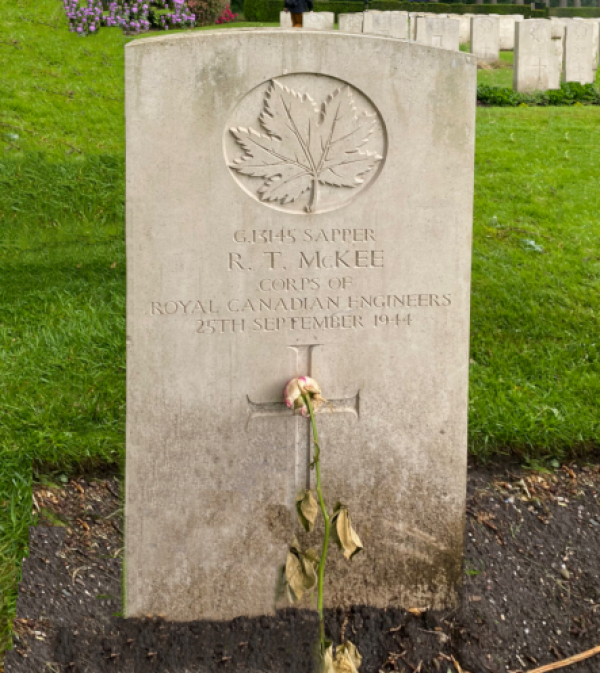
Oosterbeek
At the time of his death, Sapper Ronald McKee was 36 years old, He was buried on 27 September in a temporary grave at Orrel, Holland. His brother visited this grave while he was serving overseas in the Canadian Army. Sapper McKee’s body was later moved to a permanent grave in the Oosterbeek Commonwealth War Graves Cemetery, the principal cemetery for casualties of the Battle of Arnhem. He is the only Canadian Sapper from Operation BERLIN in this cemetery. Most other Royal Canadian Engineer losses are buried downstream of Arnhem.
In recent years, after the annual remembrance service in the Commonwealth War Graves Cemetery in Oosterbeek, NL, for the Battle of Arnhem, Bill McVean, a Canadian knowledgeable in Op BERLIN, has gathered Dutch students around Sapper McKee's grave to sprinkle some sand that has been brought from Canada to honour the Royal Canadian Engineers lost in Operation BERLIN. The sand comes from an area where one of the engineers was born or from a place related to Military Engineers' work. "They did not come home to Canada so some of Canada is brought to them."
For his service to Canada, Sapper McKee was awarded the Canadian Volunteer Service Medal and Clasp, the France and Germany Star, the Defence Medal, the 1939-1945 Star, and the 1939-1945 War Medal.
Prepared by LCol Ken Holmes (Ret’d) with material provided by students from Canisius College in Tubbergen, The Netherlands.
Return to the Op BERLIN Tributes page