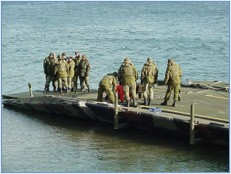
For the past 50 years, Reserve Force Engineers from across Canada have come together during the Christmas period to enhance their combat engineering skills. While the name has changed, the exercise that began in 1976 continues to this day.
It all started with 8 Field Engineer Regiment's (41 Combat Engineer Regiment) Exercise QUARREL JUMP, which was held between Christmas and New Year's at the Canadian Forces School of Military Engineering in Chilliwack, BC. Training on the Medium Girder Bridge (MGB) and the Light Floating Bridge (LFB) was possible because the CFSME equipment was not in use by courses during that period. The success of the exercise relied heavily on the support of 3 Field Squadron, CFSME, and Canadian Forces Base Chilliwack.
By the early 1980s, participation had expanded to include all Reserve engineer units across Western Canada, with as many as 250 engineers deploying for the five-day exercise. The focus shifted from non-tactical bridge-building to more tactical operations, including bridge trains and with ‘opposing forces.’ The scope grew over the years to encompass Reserve engineers from across Canada as well as members of the US Army Corps of Engineers.
In 1996, when the exercise was halted due to a severe snowstorm that struck the BC coast, the Reserve engineers were well-positioned to assist civil authorities in rescuing stranded motorists and conducting medical evacuations during Operation PYRAMID.
By 1997, the future of the exercise was uncertain due to the relocation of CFSME to Gagetown NB, along with its equipment. Instead of cancelling, the exercise was adapted and moved to Wainwright AB, where the MGB and Acrow Panel Bridge were stored. This change brought its own challenges, with bridge-building occurring in temperatures as low as -25 °C.
In 2003, the exercise returned to Chilliwack, where a newly established Reserve engineer squadron was located. Because the participants had completed the essential training courses, they were able to conduct Medium Raft (MR) training without requiring support from the Regular Force. The equipment for MGB and MR operations was moved from the Wainwright Engineer Depot in December and returned in the spring.
The exercise was further expanded in 2009 to include disaster-response components and the participation of other branches and services. This led to the start of Exercise PALADIN RESPONSE.
Over the past two decades, units from 39 Canadian Brigade Group have provided support, integrating disaster-response tasks into the exercise's framework while maintaining a focus on bridge-building and combat engineering.
Part of the success of this longstanding exercise is attributed to the assistance of Regular Force engineers and civilian support personnel. The tri-component nature of the Canadian Military Engineer family - comprising regular, reserve, and civilian members - has resulted in a remarkable partnership that has made this training event one of the most successful in the Canadian Army.