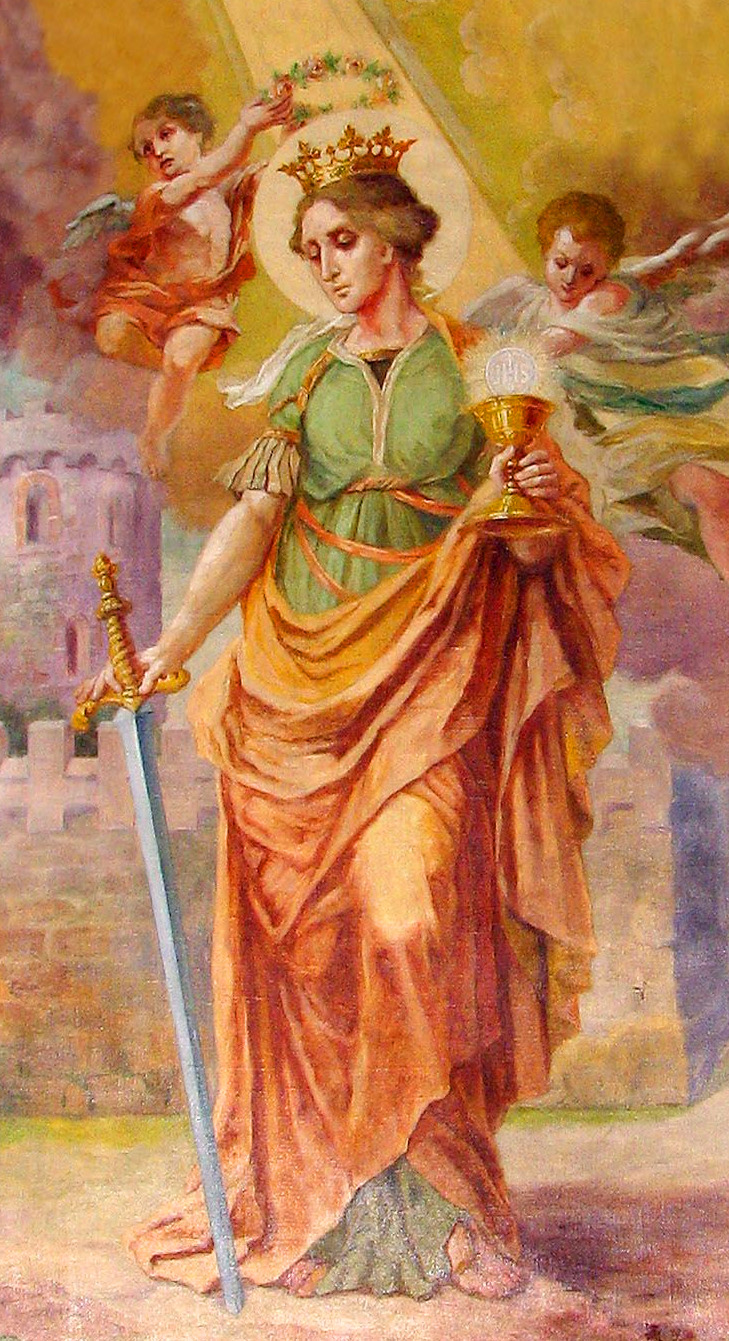
The Canadian Military Engineers have no official patron saint, but Engineers frequently participate in celebrations honouring St. Barbara. Within military tradition, she is widely regarded as the patron saint of occupations connected to lightning, fire, and explosive forces - hazards that have long been central to the work of sappers, miners, and gunners. Many armies shaped by European military heritage incorporate St. Barbara into their branch customs. Her feast day on 4 December is commonly observed across artillery and engineer communities. Although this date is the liturgical feast day commemorating her martyrdom, it is often incorrectly referred to as her birthday.
The story of Saint Barbara is considered legendary, with written accounts appearing centuries after the time she was said to have lived. According to tradition, she was born around 300 AD and was the only daughter of a wealthy pagan named Dioscorus. Fearing the influence of Christianity and determined to control her future, he confined her in a tower to keep her isolated from the outside world and to prevent any man from seeking her hand in marriage. Despite this confinement, Barbara secretly embraced the Christian faith. When her father learned of her conversion, he delivered her to the authorities, who ordered that she be tortured and executed. Dioscorus himself carried out the sentence by beheading her. As the story goes, Barbara prayed that all who sought her aid would receive it. At the moment of her death, a violent storm erupted, and amid thunder and lightning, her father was struck down and consumed by fire.
Because of the dramatic circumstances surrounding her martyrdom, St. Barbara became associated with lightning and sudden death. When gunpowder was introduced to Europe, soldiers and engineers invoked her protection against accidental explosions, misfires, and other dangers inherent in early artillery and mining work. Her image was once commonly placed on arsenals, and the magazines of French warships are still called a ‘Sainte Barbe’ in her honour. Over time, she became firmly established as the patron saint of gunners, miners, and all who work with explosive materials.
In 1969, due to questions about the historical accuracy of her story, St. Barbara was removed from the General Roman Calendar. Nevertheless, she remains a recognized saint and continues to be widely venerated, especially within military communities. Combat engineers maintain a particular connection to her because their duties -demolitions, breaching, mine clearance, and handling explosives - mirror the very dangers she is believed to guard against. For this reason, her protection is still invoked by those who face the sudden, unpredictable hazards posed by explosive forces.