Article by Greg Laychak - Chilliwack Times
Reprinted from the Chilliwack Progress 9 November 2016
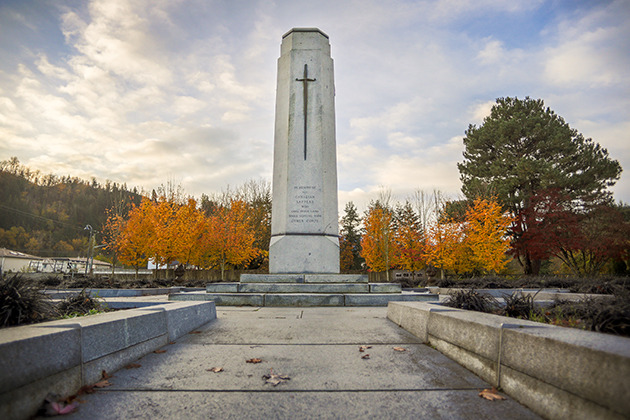
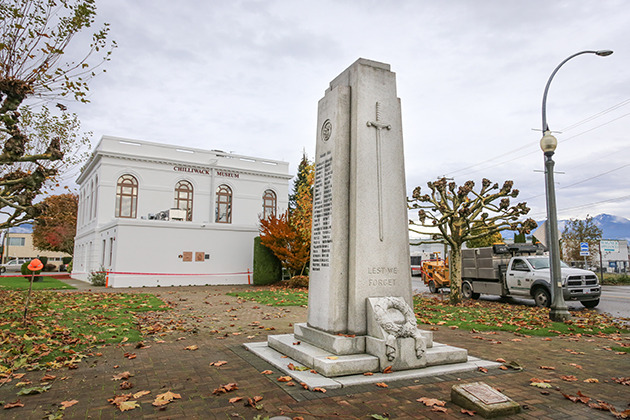
Two city employees trim trees and clear branches and leaves around the Chilliwack War Memorial behind the Chilliwack Museum Monday morning.
It’s an annual ritual, preparing the site for the fast-approaching Remembrance Day ceremony.
Like the lost soldiers honoured and their living veteran counterparts, these spaces are more closely attended to around November 11 as they re-emerge from the city’s background.
“For returning soldiers who have survived, [memorials] are enormously significant,” says Molly Ungar, associate professor in the Department of History at the University of the Fraser Valley. “It’s a focal point for them to go somewhere and remember but it’s also a means by which a community can see them on days like Remembrance Day. At these significant spaces, the public can say thank you to those who have sacrificed for their country and see that the community was involved in something life-altering, bigger than itself, and international." she says.
And it can be a starting point for education and further study into war history.
One would be hard-pressed to find a Canadian who does not think war memorials are good to have in their city.
But despite the many conflicts involving Canadian troops over the decades, few monuments have been built in the country since after the First World War, according to Unger.
“I don’t think it’s less enthusiasm, but the effect of World War II was not the same as the effect of World War I,” she says. “[They had] two different effects on the population.”
"The impact of the total number of deaths and per capita deaths the First World War had on Canada can be linked to the amount of money, time and passion spent across the nation on memorialization", Unger says.
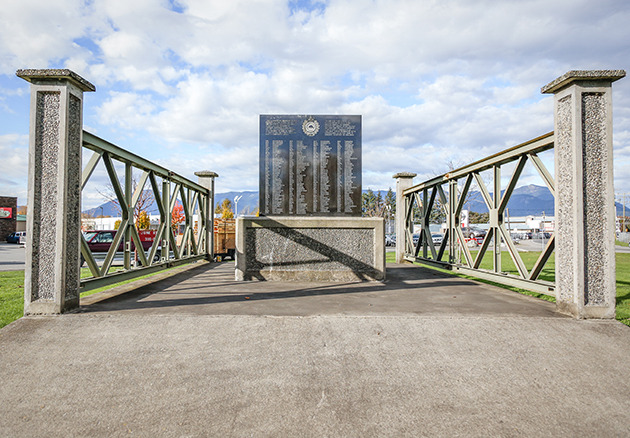
“The monuments in downtown Chilliwack and at Vedder Crossing encompass all those that served,” says veteran Jim Harris who is known locally for founding and managing the Canadian Forces Base Chilliwack Historical Society (CFBCHS). The Second World War, the Korean War and the Afghanistan War have been added to both of those memorials—Chilliwack War Memorial and All Sappers Memorial.
Ungar backs that up, saying a lot of the cenotaphs in Canada are for the First World War but with names and wars added later.
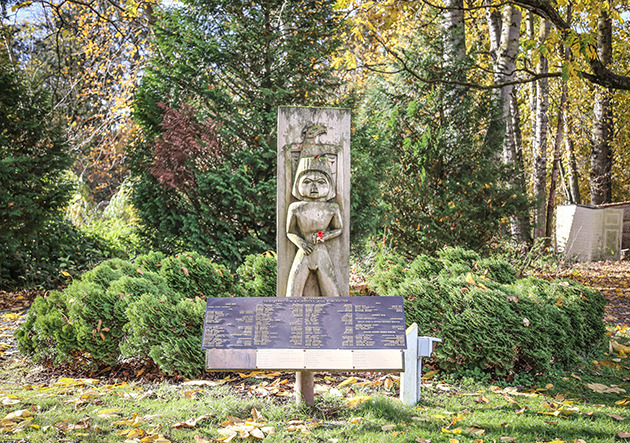
If that’s the case then Chilliwack is an exception to the rule, boasting a number of newer, unique memorial projects ranging in accessibility.
Digital Memorial
The Internet age has made a massive difference for Ungar and her students’ research, so they decided to harness that power into a digital war memorial of sorts.
Two years ago, under Ungar’s supervision, the Chilliwack Poppy Project was born. The interactive maps show the exact addresses of local First and Second World War soldiers who did not return to Chilliwack.
“It’s extraordinarily resonant because this could be the house across the street from where you live and somebody left there in 1915 and never came back,” Ungar says. “That person actually walked here where I’m walking and this was a life-altering experience for the family and, of course, for the person who died. It changes a person’s perspective of their community and it adds a layer of meaning to that community", she adds about her team’s application of “geography of memory.”
And though there are many online resources that make things faster and easier for projects like Ungar’s, the historian admits the starting point for her virtual monument was the list on the Chilliwack War Memorial itself.
The Poppy Project represents the epitome of easily-reached war memorials. A click of the mouse or a tap of the tablet will bring the inquisitive to their destination.
But on the opposite scale of accessibility, Chilliwack has some more remote tributes to remembrance.
There’s the Airplane Creek Memorial at Thompson Regional Park on Chilliwack Lake Road—a monument of recovered aircraft engines, itself a rebuilt version of older monuments constructed deep in Chilliwack’s surrounding mountain terrain. Made to honour the crew of Liberator bomber KK241—a Second World War aircraft that crashed into the side of Mount Welch on June 1, 1945—the new version was rededicated just last fall near the roadside.
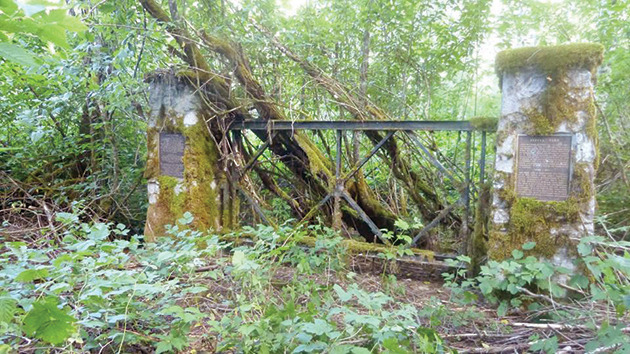
Continuing down to Chilliwack Lake, a drive along the Chilliwack Lake Forest Service Road or a boat ride down the large stretch of water would bring you to an isolated, overgrown monument that turned 45 this year.
Sapper Park (not to be confused with the monument of the same name on Young Road) was built and dedicated at the southern tip of Chilliwack Lake in 1971.
“We’ve started a plan to have it cleaned up, it’s being worked on as we speak,” says Harris. “I expect next summer we’ll probably see it finished.”
The former Royal Canadian Engineer (RCE) Master Warrant Officer is a man of action, having a hand in many of the war memory efforts in town and beyond.
With bridges washed out and the monument covered in forest growth, Harris is setting his sights on not just the restoring of the structure. He also wants a trail built to it and signage to build awareness of the site that was used by Royal Engineers during their surveying mission of the Canada/US border in the 1800s.
It’s hard to imagine the now-secluded site was attended by 500 people at its dedication in the early ‘70s.
However, few memorials are as remote or of the size and scope of Neil Grainger’s Mountain Project. A former member of the local Search and Rescue team, Grainger had a peak named for his brother Frank who died in Ireland in 1943. It was part of a nationwide program of the Canadian Permanent Committee on Geographical Names to rename geographical features for fallen war veterans.
“If a guy’s going to have a monument, that’s quite a monument,” he says of Grainger Peak.
It took him three years to summit his brother’s namesake feature, building a trail through the wilderness.
“Trying to deal with the death of my brother was quite a part of it,” Grainger says. “It was instinctive, it was something that I felt I had to do.”
He began climbing other peaks and features named after veterans leaving commemorative crosses on each and enlisting help to complete what had become a compulsion.
After he personally hiked 20 of the features, and other volunteers rounded that number to 67, Grainger published his notes and stories with photos in a book called The Mountain Project.
Now 89, he says his son Darcy, a 56-year-old based in Kelowna, recently started following dad’s path of memorial-by-ritual and hiking the peaks Grainger highlighted in his project.
Look to the future
While monuments can take different forms and Chilliwack is more inclusive than many communities, there are more ways in which specific populations can be represented locally.
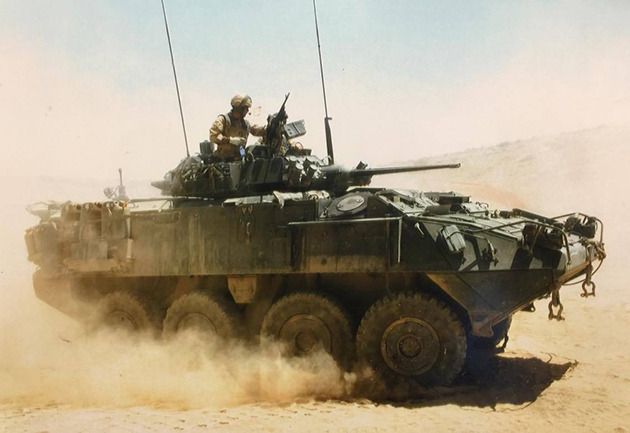
Spearheading a movement to get a memorial for Afghanistan veterans in the city, Aaron Bedard has zeroed in on the LAV III mechanized infantry vehicle as a cheap, easy candidate.
General Dynamics Land Systems is making 300 frames of its ($2.7 million when fully kitted) carrier available for $15,000 as a replica for towns across Canada who apply.
“We were living out of that thing 24/7 for six months, it kept us alive,” says Bedard of his own Afghanistan tour. “It was the best vehicle out of any western . . . army over there doing operations.”
Chilliwack city staff are researching the costs of bringing the LAV III to town and plan to bring the item to council this month, but they don’t expect a resolution until December at the earliest.
Bedard is hoping to use the opportunity to find the 20 or 30 local young vets from modern wars to help them feel more like a part of the veteran community.
“This is something that’s valuable to the Afghan vets in terms of their closure and moving on and transitioning away from this experience of war, to always know that they can go back to a spot in a park somewhere and sit near that big machine that we called home that is like a turtle shell that we lived in.”
As Ungar mentions, in Canada we are nowhere near a saturation point with monuments. It’s the enthusiasm for raising funds and resources that has generally waned.
But to veterans, and those who gave the ultimate sacrifice for their country there can be no forgetting.
And these important symbols ensure all Canadians remember.