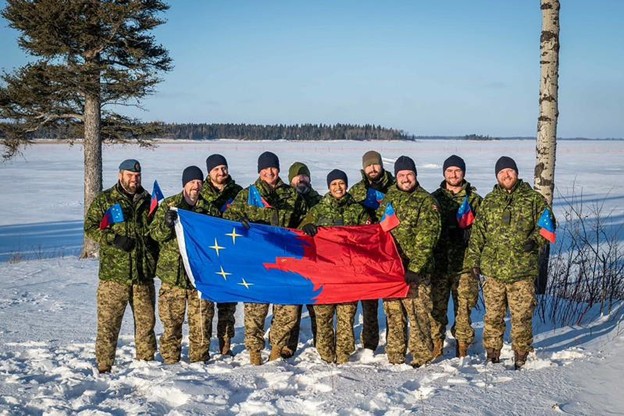
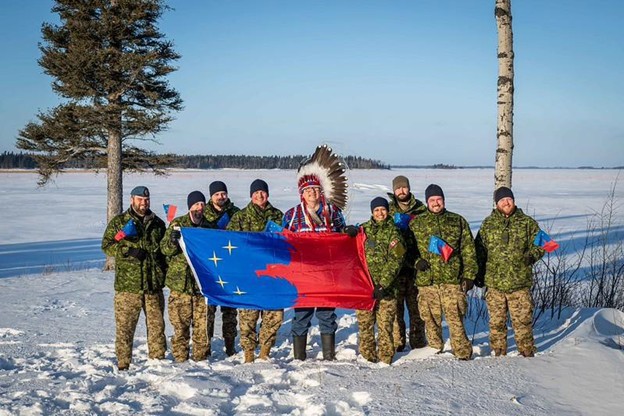
Written by Capt Chris Kincaid, 1 ESU, DS Troop Comd
From 11 – 24 January 2026, the Canadian Armed Forces (CAF) deployed a specialized Technical Assessment Team (TAT) to assist the Pimicikamak Cree Nation (PCN) in Cross Lake, MB, after a 6-day power outage and extreme cold left the community in a state of emergency. The TAT was comprised primarily of members from 1 Engineer Support Unit, and its mission was to assess damage to the critical infrastructure and provide recommendations to remediate deficiencies.
On 28 December 2025, a remote section of the main power distribution line to Cross Lake failed, leaving over 7500 people without power amid extreme winter conditions. As temperatures dropped below -40°C, the loss of heat and electricity quickly became a threat to the safety of the community, leading to the evacuation of nearly half the population. Once power was restored, the community began to assess damage to homes and critical infrastructure. The scale of damage from the freezing temperatures left the community in a state of emergency and prompted the Request for Assistance (RFA) to the Government of Canada.
In response, the CAF deployed a TAT composed of 10 personnel, including seven construction engineering trades specialists from 1 ESU to Cross Lake from 11–24 January 2026 to conduct rapid engineering assessments of critical infrastructure. Guidance and recovery recommendations for the following five criteria were requested through the RFA: sewage treatment, water treatment, electrical generation, project management, and logistics.
While two Non-Governmental Organizations assisted with residential repairs and evacuation efforts, the TAT focused their assessment on the most critical systems: the water treatment plants, sewage treatment systems, and key backup power generators in the community. The assessment focused on evaluating the performance, capacity, and reliability of the infrastructure while identifying measures to remediate deficiencies. Over the following days, the TAT worked diligently to complete their evaluation to produce two documents, an assessment report and a recommendation report.
Based off their assessment, the TAT determined that the community’s infrastructure was facing several significant challenges. At the water treatment plants, the power outage and freezing temperatures caused multiple pipes to freeze and burst. Although operators were able to repair the damaged pipes, the aging condition of the equipment has resulted in ongoing maintenance difficulties. The community also had several backup generators supporting their key infrastructure, however, many were not appropriately sized for the required loads or had experienced failures in critical components. Furthermore, over a year ago, a fire at the sewage treatment plant severed the main power connection to the plant, which in turn restricted the community’s ability to treat sewage. The overall condition of the infrastructure assessed was detailed in the assessment report, with the recommendation report outlining potential measures for repairing and improving the systems moving forward.
With the provision of these two reports, the PCN leadership was incredibly grateful for the work done by the CAF and felt they were in a better place to implement both short and long-term solutions with the provided recommendations. Rapid support to this mission was made possible by 1 ESU’s specialized engineering capabilities and high readiness mandate. 1 ESU’s experience conducting facility condition assessments (FCA) on domestic and deployed infrastructure formed a baseline for how this mission was conducted. This knowledge alongside the engineering expertise at the unit helped adapt these FCA practices to the uniqueness of this mission. Having this experience to rely on was essential for success with the quick turnaround of the mission. CAF resources were activated on 8 January 2026 with the TAT deploying on 11 January 2026, leaving little time for preparation. Several members from the TAT were recalled from holiday leave to deploy with less than 48 hours' notice, emphasizing the importance of unit readiness to supporting sudden, expedient operations.
For the entire duration of the deployment, the TAT was met with sincere hospitality and support from the community. Local leadership and residents welcomed the members of the TAT, shared meals, offered accommodations, and worked alongside them throughout the assessments, enabling the work to progress efficiently and making the mission especially meaningful for all involved. The mission reinforced the professionalism and technical expertise that Canadian Military Engineers can bring in support of domestic operations.
The TAT was composed of 10 service members from three units:
- 7 x 1 ESU,
- 2 x Combat Camera, and
- 1 x 1 PPCLI.
The TAT included the following:
- Comd – LCol Aarthi Prabhakaran,
- SM - CWO Guy Thivierge,
- Ops/Eng O – Capt Samuel Kincaid,
- CE Supt/PH Tech – WO Karl Lambert,
- EGS Tech – Sgt Christopher King,
- ED Tech – Sgt Michael Uleryk,
- WFE Tech – Sgt Tyler Stewart,
- PAO – Capt Jonathon Farlam,
- Img Tech– Avr Daniel Bartchouk, and
- 3 Div LN O – Capt Alexandre Rousseau.