The Allied campaign in Italy during the Second World War is often described as “an Engineer’s War” because of the difficult terrain and the extensive obstacles created by the enemy.
In December 1943, the German Army withdrew to the Bernhard Line, positioned across the narrowest part of the Italian Peninsula, in an effort to halt—or at least slow—the Allied advance. This defensive line crossed mountain rivers swollen by winter rains. German engineers reinforced it by demolishing most of the bridges to the south, cratering roads in narrow passes, tearing up railway tracks, and laying minefields in craters, along road edges, and in open ground. Towns and villages were also heavily fortified with additional demolitions, mines, and booby traps.
By this stage of the campaign, the engineers of the 1st Canadian Division were already fully committed. Their tasks included building bridges, clearing minefields and booby traps, filling craters, and creating bypasses—along with countless other duties—to keep tanks and heavy vehicles moving forward.
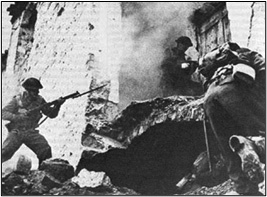
On 21 December 1943, the Loyal Edmonton Regiment and the Seaforth Highlanders of Canada, supported by tanks from the Three Rivers Regiment, entered the coastal town of Ortona—the eastern anchor of the Bernhard Line. There, they encountered what has been described as some of the most intense street fighting in modern warfare up to that point. Engineers and infantry assault pioneers played a critical role in clearing obstacles, but the battle quickly turned into brutal house-to-house combat against a determined enemy.
Fighting from one building to the next was slow and dangerous. Soldiers were exposed to close-quarters combat inside buildings, and to enemy fire from streets and rooftops as they moved between them.
To overcome this, Canadian troops developed a technique known as “mouse holing.” This involved creating openings in the shared walls between adjacent buildings, allowing soldiers to move from house to house without going outside. Engineers supported the infantry by breaching walls using hand tools or explosives. When enemy forces occupied the upper floors, large demolition charges were sometimes used to collapse the structure.
By moving under cover and avoiding exposed streets, Canadian forces were able to drive the enemy out of the city. The success of this technique led to its adoption by other Allied armies.