Throughout Canadian military history, mascots have played a vital role in embodying traditions and fostering camaraderie. One notable mascot was Johnny Canuck, a German Shepherd who, lore has it, parachuted with the 1st Canadian Parachute Battalion on D-Day during the Second World War, and tragically perished alongside his handler.
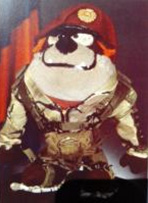
TAZ, a stuffed Tasmanian devil, became the beloved mascot of the 2 Combat Engineer Regiment's Airborne Grouping in the 1970s. TAZ made his debut with 1 Airborne Field Squadron in 1975 and quickly became an integral part of the unit. His introduction to parachuting was unconventional; he jumped from the roof of a barrack block, showcasing his eagerness to join the team. Equipped with custom-made gear, including a silk parachute and camouflage smock, TAZ embodied the spirit of independence and loyalty characteristic of airborne engineers. He received official identity discs from National Defence Headquarters but disliked being referred to as having "dog tags."
As a loyal member of the airborne community, TAZ participated in numerous jumps, often accompanying new jumpers on their first descent to boost their confidence. He cheekily referred to them as "baby jumpers" and would yell: "Release me!" during descents. TAZ never required refresher training due to his professionalism and commitment to maintaining jump integrity.
One memorable incident occurred during a jump onto Drop Zone Anzio at CFB Petawawa on a windy day when TAZ became separated from his comrades and disappeared into a water-filled depression. Despite extensive searches, he was missing for months, leading to mourning among paratroopers. He was eventually found during the dry season, albeit in rough shape after battling an unseen adversary. After repairs and cleaning, TAZ rejoined his comrades with his characteristic humour.
TAZ also faced challenges from rival units that attempted to kidnap him as a trophy. A successful attempt by the Airborne Military Police resulted in some public humiliation for TAZ but ultimately led to his release after fellow paratroopers met the ransom demands. Among TAZ's proudest moments was receiving United States Army Parachute Wings after completing five jumps with U.S. paratroopers at Fort Bragg.
His travels continued when he accompanied his unit on a jump into Colorado in 1980, where he became popular among locals while sharing stories and enjoying local culture. Over fifteen years, TAZ completed over one hundred jumps from various aircraft types. However, his airborne career ended in 1995 when the airborne engineers were disbanded following the Somalia Affair. Heartbroken by this change, TAZ unofficially retired but remained cherished by those who served alongside him. To honour his legacy, fellow engineers built him a reinforced cage with all the comforts of home.
TAZ's story is a testament to the spirit of over five hundred soldiers who served with the airborne engineers between 1955 and 1995, ensuring that his legacy endures within their hearts. LCol Doug Foreman's book "50 Years of Airborne Sappers" features an article dedicated to TAZ.